I’ve lived in Cozumel for years. I knew this island was one of the world’s top diving destinations. Almost everyone I meet here dives, or works around diving, or knows someone who does. People save money all year to fly here for a one-week trip and spend the whole time underwater. For most divers worldwide, Cozumel is on the bucket list.
And for the entire time I’ve lived here, I hadn’t gone diving once.
Living on a small island has its own slow attrition. You learn every corner of it, the same restaurants, the same beaches, the same routes. The “what should I do this weekend” question gets harder. So at some point the “what if I just tried diving” thought started showing up, and once I noticed how many divers were around me every day, it became harder to ignore. I live in one of the world’s great dive spots and I’ve never been underwater. What’s wrong with me, right?
So in May 2026 I finally did the Discover Scuba program at a local shop. It was a 2-day Extended format: no certification, three dives, 129 minutes underwater, capped at 12 meters. Three nurse sharks, a sleeping turtle, a parrotfish pooping out white sand. This article is what actually happened, what I was wondering about beforehand, what was real, what wasn’t, and what I’d tell anyone else thinking about it. I paid for it myself, no discount, no media invite, no free dive in exchange for writing about it.
What Discover Scuba Actually Is (vs Snuba, vs Helmet Diving)
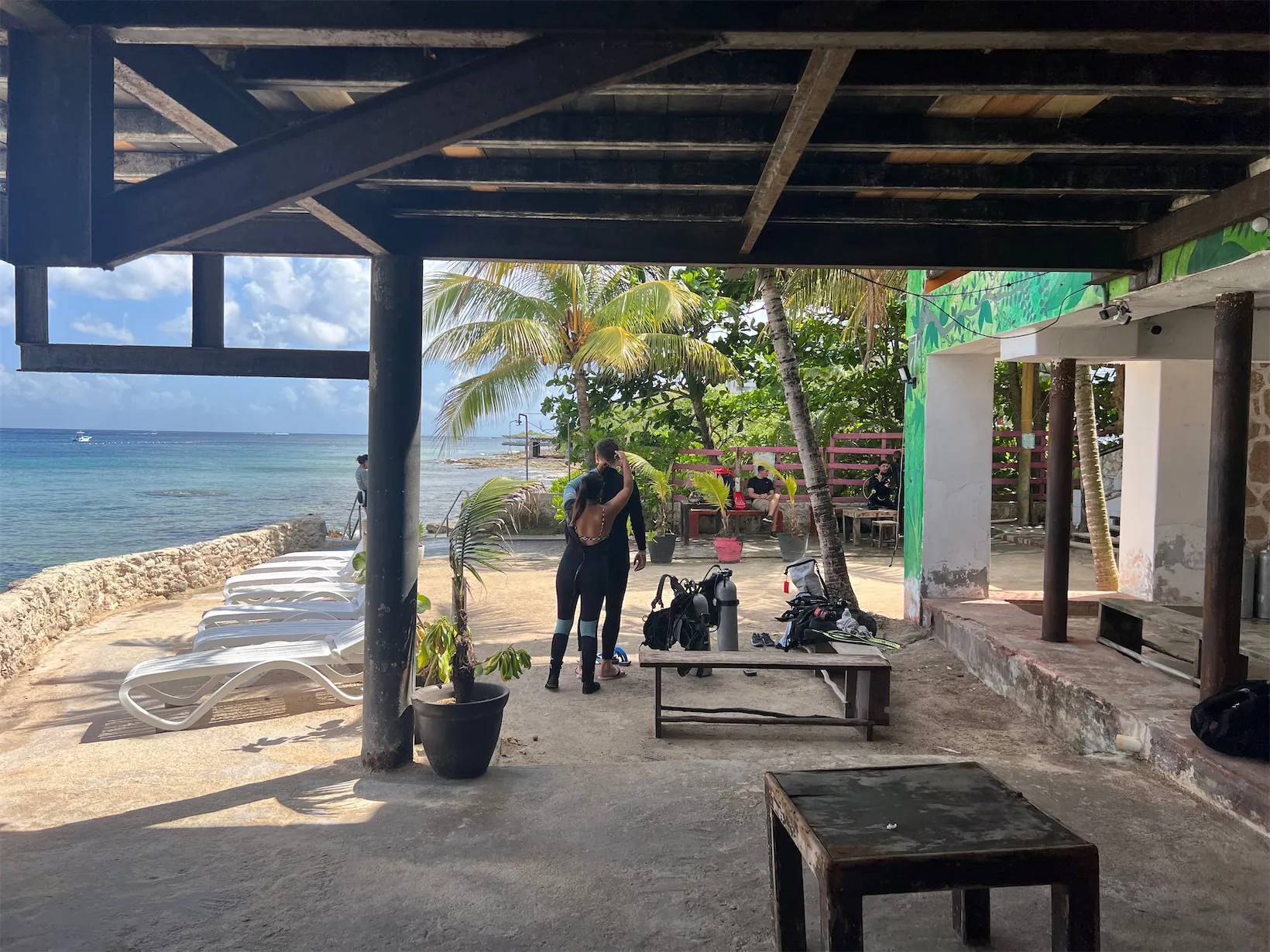
Discover Scuba Diving, or DSD, is a short introductory program for non-certified divers. A PADI instructor takes you underwater to a maximum depth of 12 meters (40 feet), after a brief theory session and a confined-water skills practice. You don’t earn a certification. You don’t dive without supervision. But you experience real diving from start to finish: gear, breathing underwater, buoyancy, and an actual open-water dive.
Most Cozumel shops sell DSD as a single-day program. The structure varies by shop. Some do a pool or confined-water session plus one boat dive. Some do a pool session plus one shore dive. Some skip the pool entirely and do two boat dives back-to-back, which is the fastest format and the one I’d think hardest about as a complete beginner. Total time on the water ranges from about 4 hours (the rushed end) to 6 hours (the more relaxed end).
A few shops, including the one I went with, offer a less common 2-day Extended version that splits the experience across two days. The full chronology of what actually happened on both days is in the next section.
For how DSD compares to Open Water certification and other paths after your first dive, see our piece on scuba diving without certification.
DSD vs Snuba vs Helmet Diving
These three sometimes get bundled in tourist-destination marketing but they’re not the same thing. DSD uses a standard scuba tank on your back with a regulator in your mouth, and you breathe self-contained underwater air. Snuba uses a tank that floats on the surface, connected to you by a long air hose, so you’re effectively snorkeling with extended breathing range. Helmet diving uses a sealed helmet fed by a surface air supply, with your head kept dry and your body upright.
Only DSD is true scuba: self-contained, regulator-breathing, normal swimming-around body position underwater. If you want to know what scuba diving actually feels like before committing to a certification, DSD is the answer. Snuba and helmet diving will get you near the reef, but they don’t replicate the part most people are actually curious about: breathing through a regulator from a tank you’re carrying.
My Discover Scuba Day in Cozumel
Day 1: Pool and Shore Dive
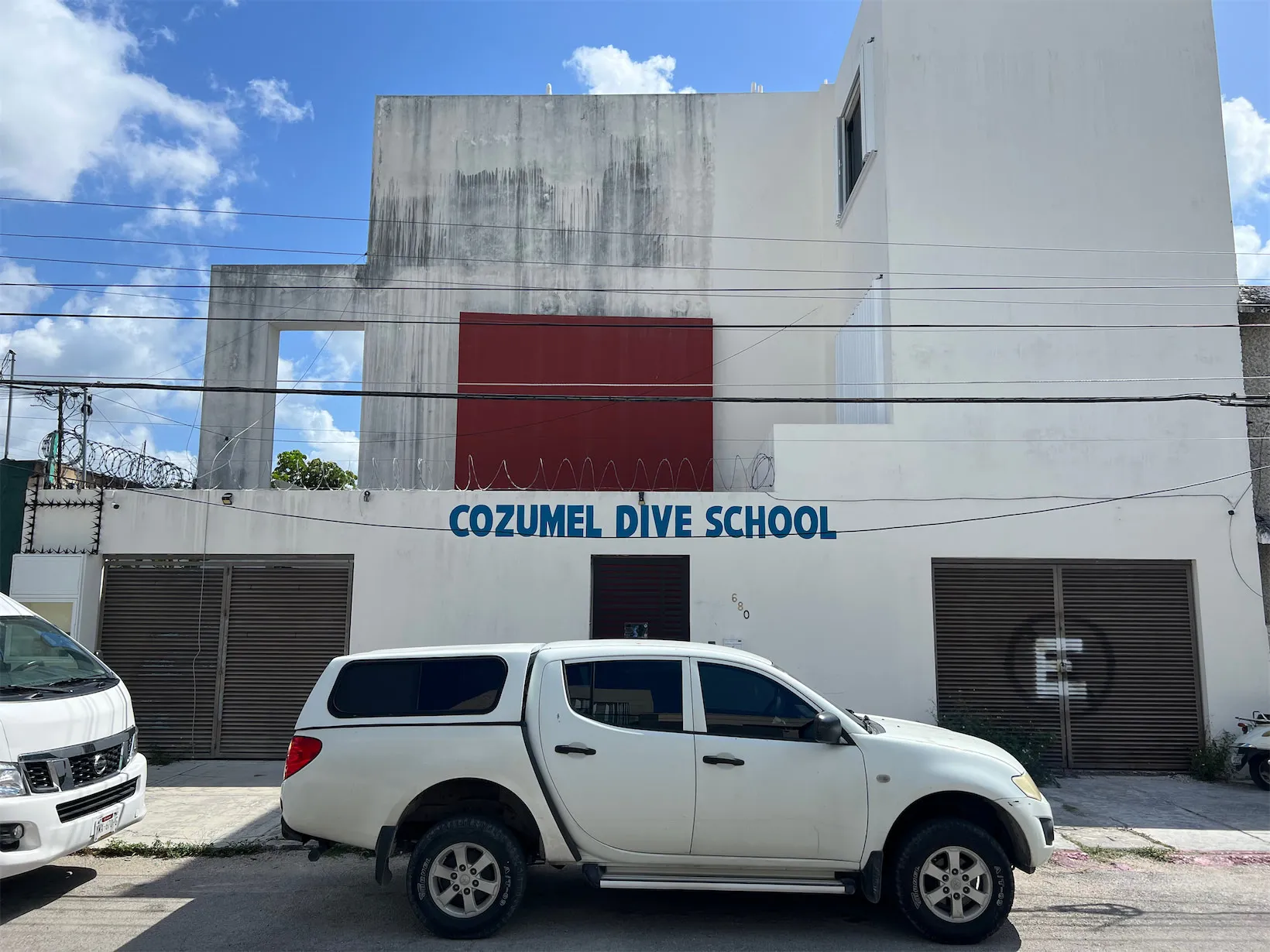
I got to Cozumel Dive School at 7:55am, five minutes early on Saturday morning, May 16, 2026. Meeting time was 8am. The premises manager greeted me, along with Kyle, my babysitter for the day, with 300 dives clocked under his belt. The school sits in a family house with a pool and a big hangout area. A few divers were already prepping to head out, and a girl looked like she was working through some kind of certification course.
Kyle and I sat down and went through the paperwork: equipment rental agreement, release waiver. The gear was included in my DSD (Discover Scuba Diving) price, so no extras to pay. He brought me my wetsuit, BCD (the buoyancy control device, the inflatable vest that controls how you float or sink), mask, and fins for the next two days. I changed into my swim suit, pulled on the wetsuit, and we got started.
No other DSD client showed up that day, so I had the luxury of one-on-one. Kyle took his time. He walked me through all the hand signals: “I’m OK,” “check your air PSI” (pounds per square inch, the pressure reading on your tank gauge), “going up,” “going down,” “something’s not right,” “terminate the dive,” “I have an issue,” “I’m low on air” (under 700 PSI). Same stuff as the PADI eLearning material I’d done at home, but it lands different when someone shows you in person.
Then he showed me how to prep the gear. Before assembling everything, he showed me how to check the air itself: take a small breath through the regulator (the mouthpiece you breathe from, which converts the high-pressure air from the tank into something you can actually inhale) and check the smell and taste. If anything seems off, something’s wrong with the air in the tank.
Then he walked me through the pre-dive check. He told me a useful mnemonic he uses to remember it: BWRAF, Beer-Whisky-Rum-Always-Fun. There are plenty of other mnemonics for the same checklist, some not alcohol-related at all, so anyone learning this can pick whichever sticks for them.
B for BCD. Inflate with air, inflate manually by mouth, deflate with the hose pointing up either manually or using one of two quick releases: one at the right chest, one at the back bottom right.
W for weight. Check your weights are on. Weights help you sink. A diver in a wetsuit is naturally buoyant and would float at the surface without them.
R for releases. Seven total on my BCD: two on the belly, one on the chest, two on the chest sides, and two on the weight pockets on the sides of the BCD.
A for air. Breathe from the regulator while quick-releasing some air from the alternate regulator, watching the PSI needle on the air pressure gauge. If the needle moves, something’s wrong.
F for final check.
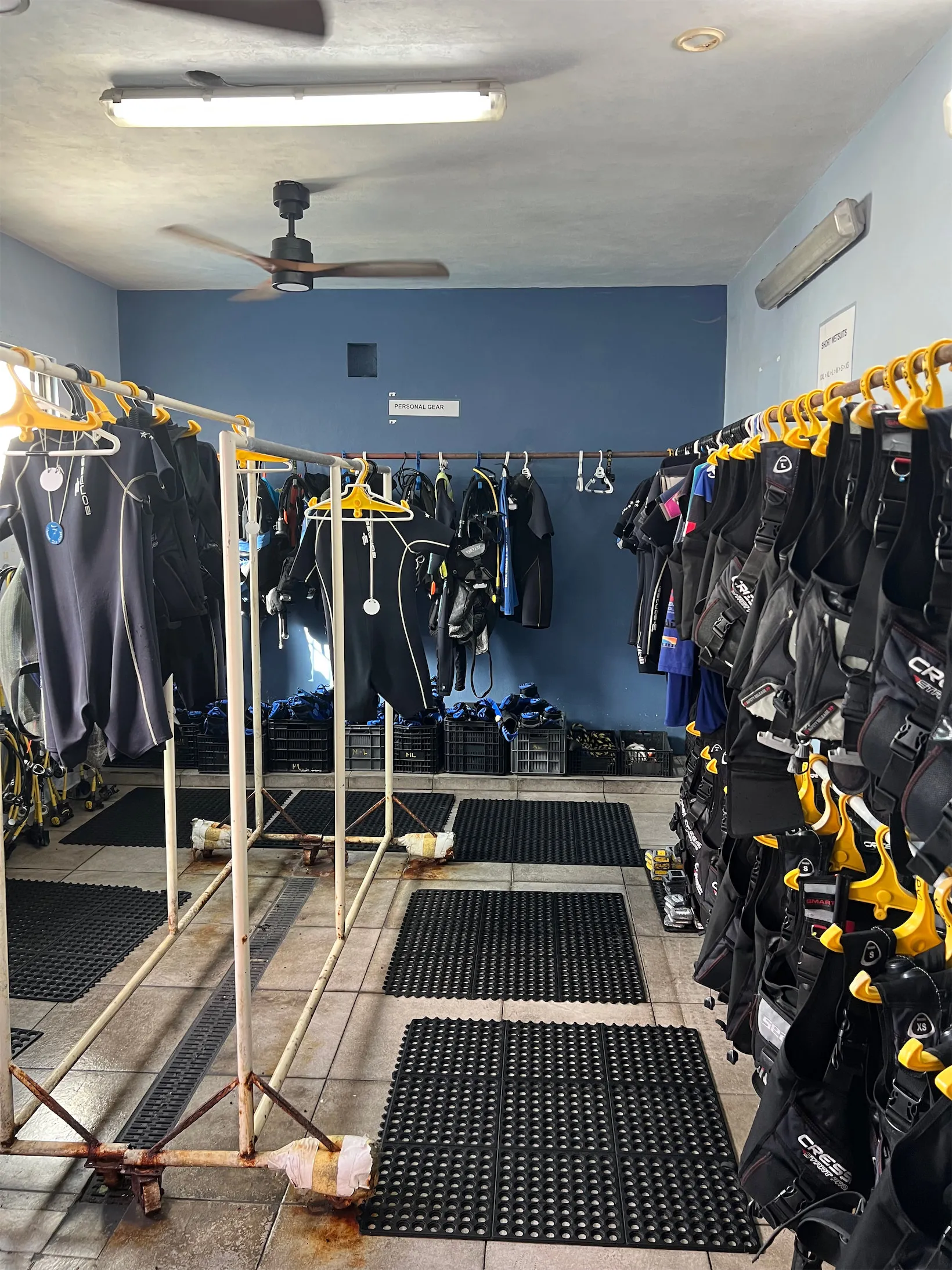
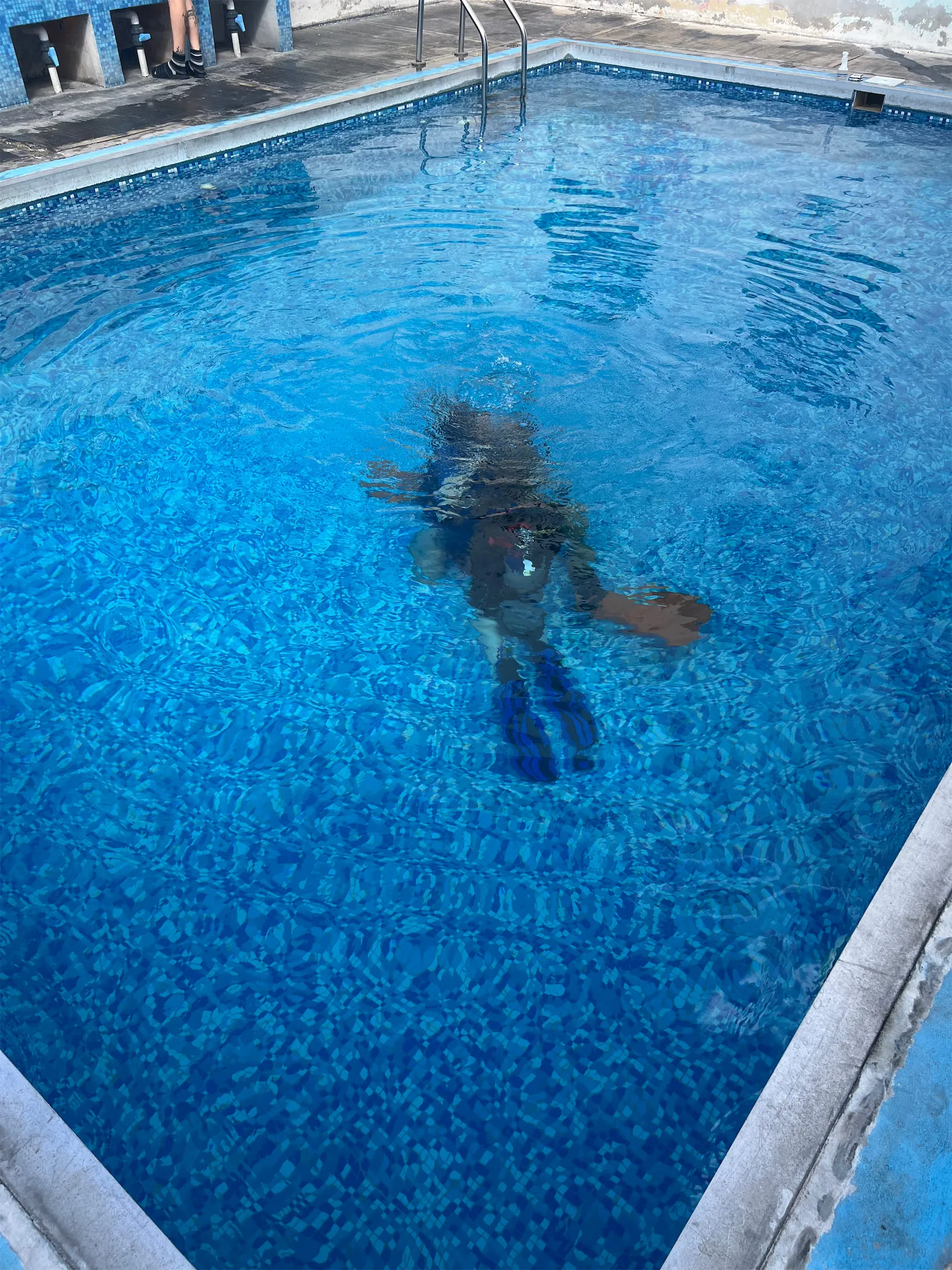
Geared up, we headed to the pool. It was shallow, maybe 1.5 meters, so to actually get down I had to kneel. Regulator in my mouth, deflated the BCD, dropped to my knees, started breathing. Kyle gave me a thumbs up, which means “go up.” I went up and heard him say, “Congrats on your first breath underwater. How was it?”
And it hit me, haha, everyone talks about their first breath underwater like it’s some unforgettable revelation. But I was so in the moment that I didn’t think of it at all. It felt kind of normal. Natural.
We practiced hand signals again, underwater this time. Then he had me clear my mask: letting water in, then blowing it out through my nose while pressing the top of the mask. That was the one thing I didn’t enjoy. It feels a little panicky to me. Breathing through the mouth and then forcing air out through your nose, water around your eyes, the whole thing isn’t comfortable. I asked to practice a few more times and I still felt like I hadn’t internalized it. After that I swam some small loops underwater and we wrapped up the pool session, maybe twenty minutes total.
From arrival to that point was about an hour and a half. We packed the gear into the school’s truck and drove to Tikila Beach for the shore dive.
Tikila is a spot dive shops use mostly for teaching. The entrance is over smooth rocks, no sandy beach, which is actually kind of nice and clean. There are outside showers and restrooms. Maybe a dozen divers were already there prepping; in the water I could see a few instructors with what looked like a rescue diving course.
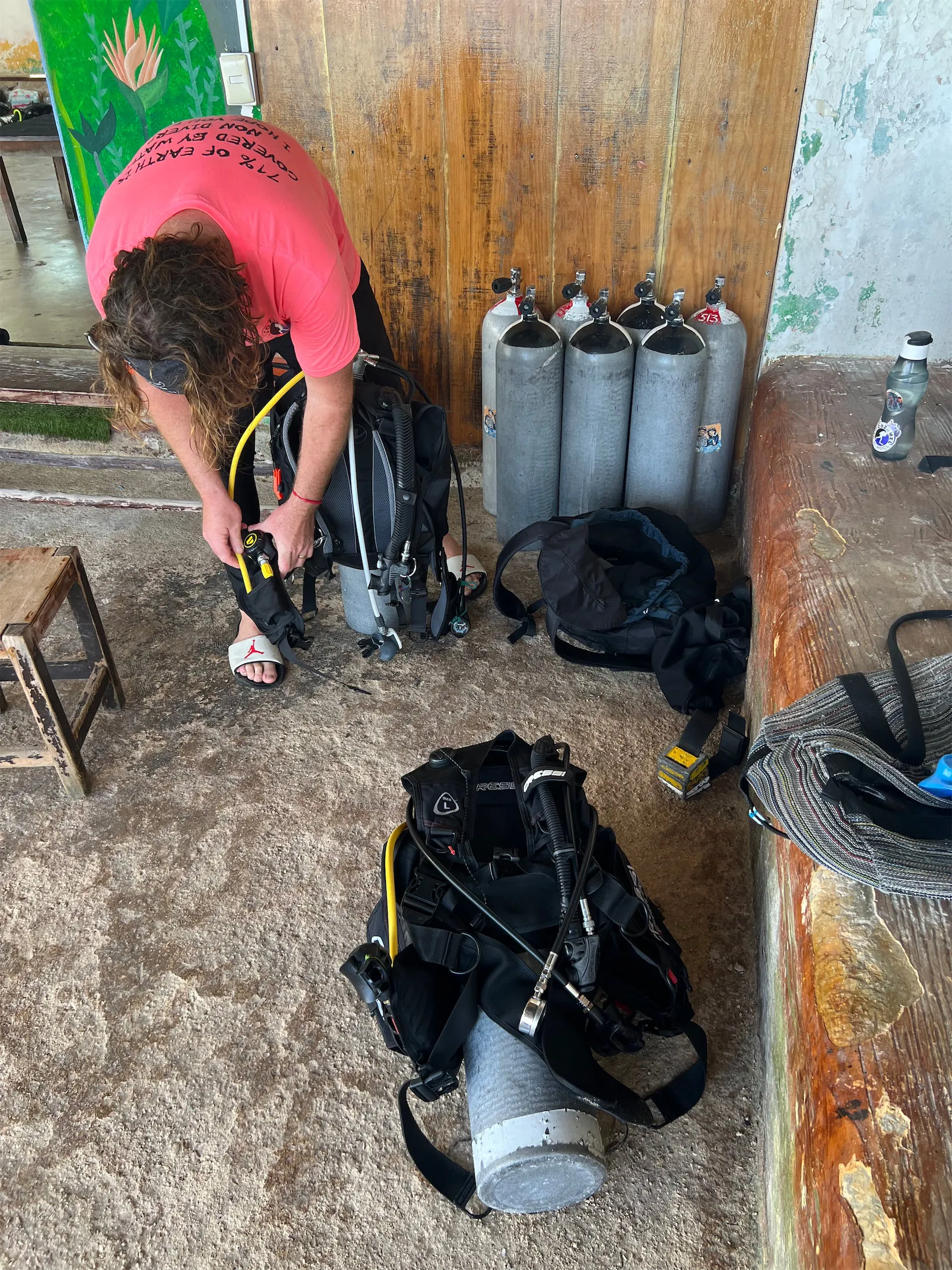
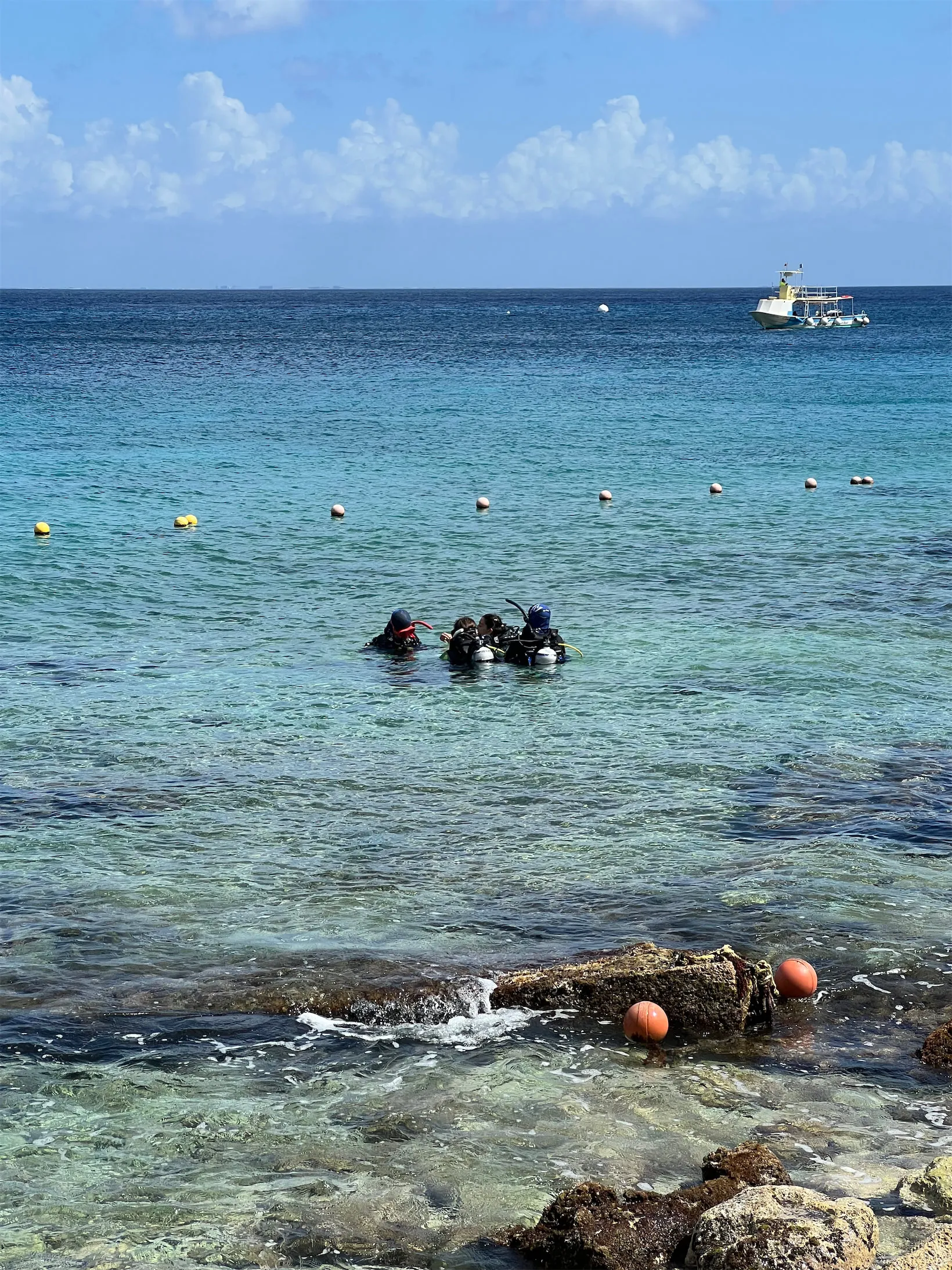
We got fresh tanks, ran through gear prep again, did the BWRAF, talked through pressure equalization and the mandatory three-minute safety stop at 5 meters. Right before we went in, Kyle explained that because this was DSD, he’d manage everything for me, and that he’d hold me the whole time. Which was, well, unexpected. I felt a little like a baby, but I figured Kyle and the school felt responsible for me, so I’d take it. Extra safety is always a good thing. He shortly previewed what we might see down there. Then we headed into the water.
We put on fins and masks in the shallows and dropped down. It took a few minutes to get deep enough to see the first school of fish, and when we did, it felt good. Seeing the life underwater is totally different from seeing it on video.
One thing bothered me from the start: I kept drifting to one side, having to work to stay level and not turn belly-up. I thought my 16 pounds of weight were unevenly distributed, but I figured out later it was Kyle holding me. The issue only showed up at the start; it faded after.
Kyle pointed out different fish along the way. We went to 8 meters max. Nothing crazy, but I started to feel a slight pain in my right ear at depth. The dive was maybe 25 minutes total, out and back. I was surprised it was over that quickly. The time went so fast.
I think Kyle was a bit tired by the end, because when we turned back the current was against us and he was pulling me alongside him most of the way. I could feel him adjusting my buoyancy, but I could also feel him dragging me back to shore.
Day 2: First Boat Dives at Paso del Cedral and Tormentos
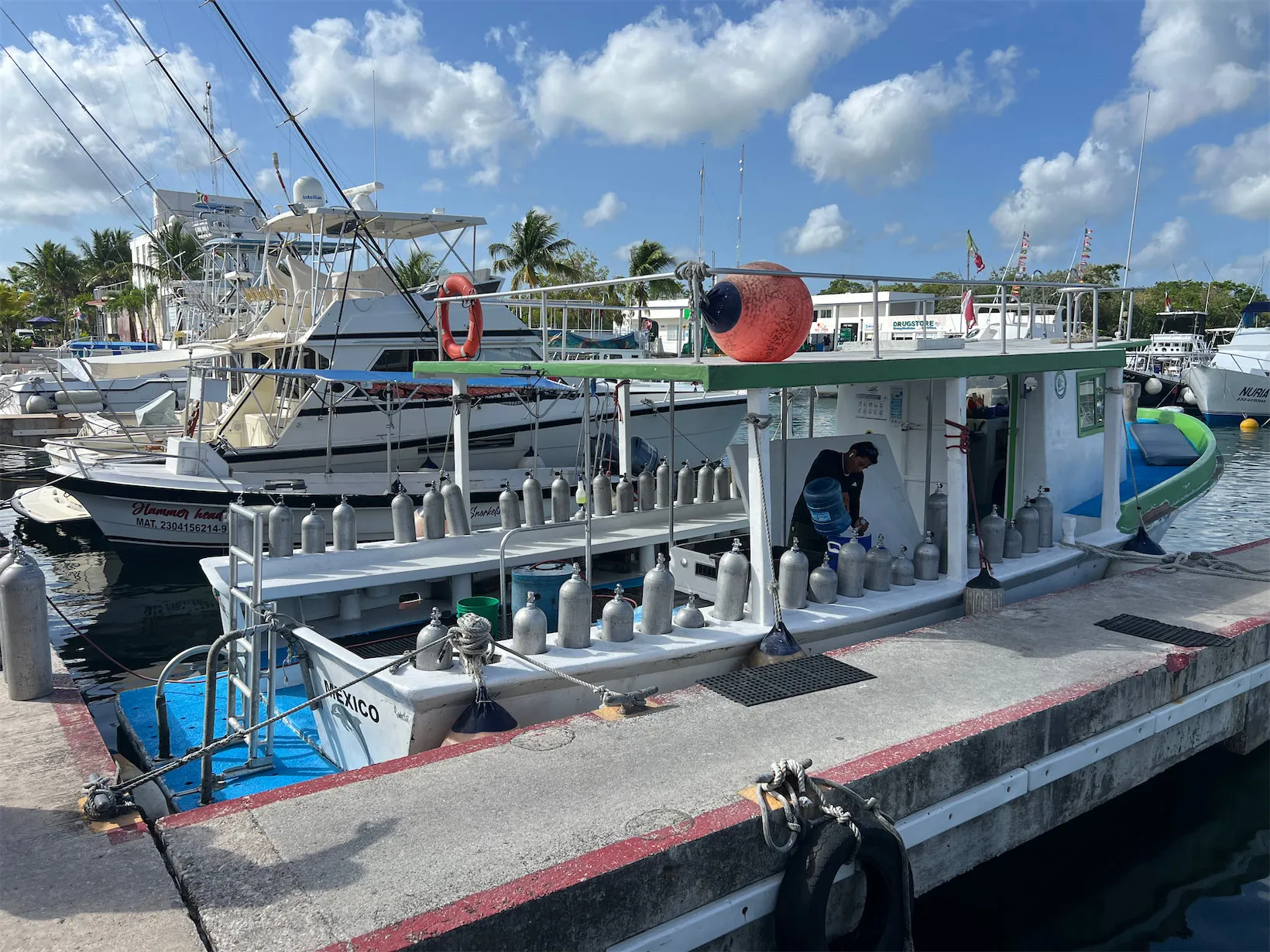
Sunday, May 17, 2026. Boat day.
Meeting time was 8:20am at the dive school. When I arrived, my instructor had already prepped my bag with the gear, so I just sat down and waited. Ten divers were going out total: four instructors and dive masters, six divers. Me with my DSD instructor; a girl with her instructor on her last OW (Open Water certification) training day; an older woman with her own dive master; three guys with theirs.
We left the school around 8:45am, fifteen minutes to the port, where the boat was waiting.
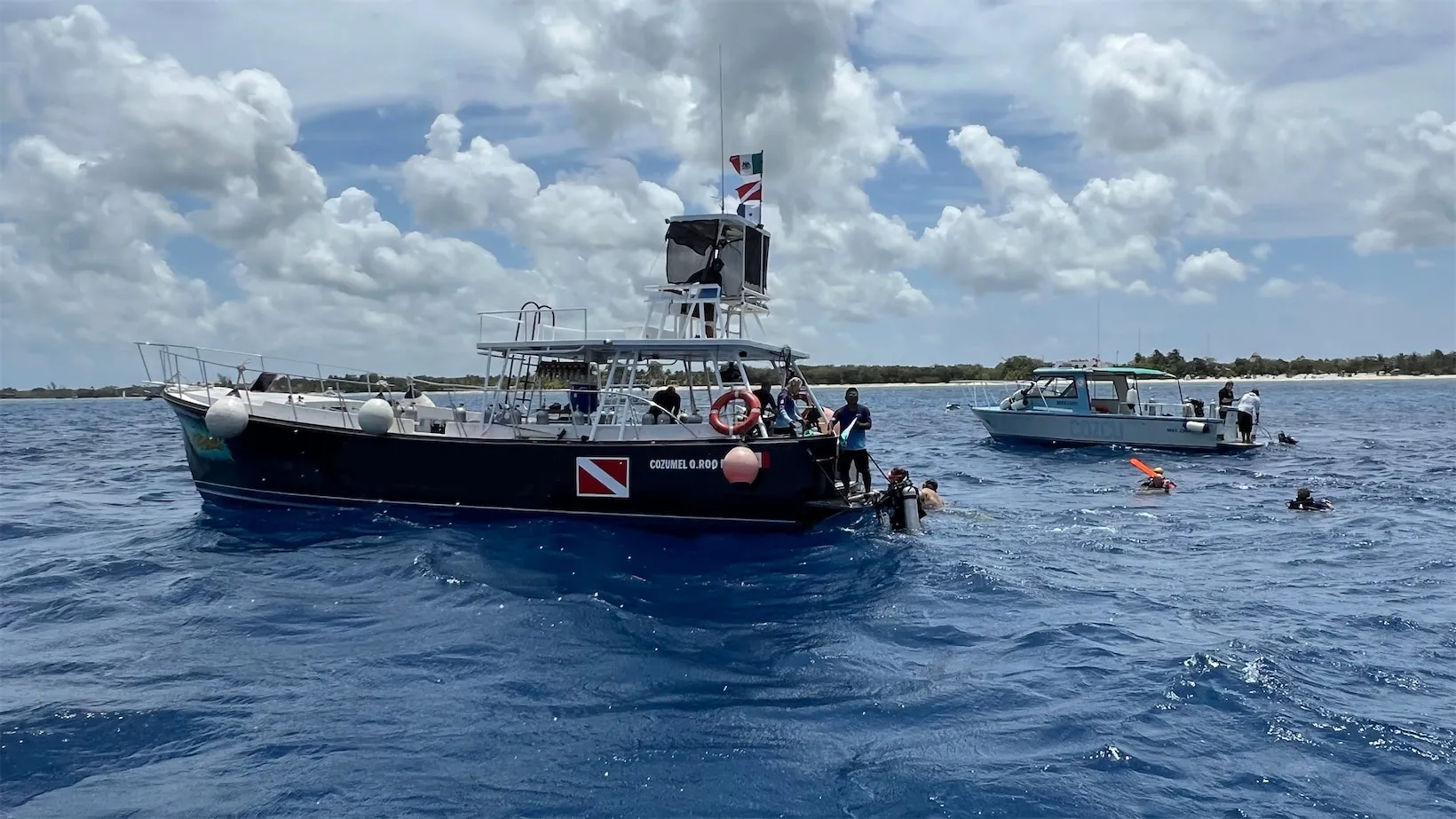
The boat was a charter with capacity for 22 divers. Our group filled ten spots; the other twelve were filled by three other shops. Once aboard, everyone started prepping their gear: check the tank, fit the BCD, attach the regulator, smell and taste the air.
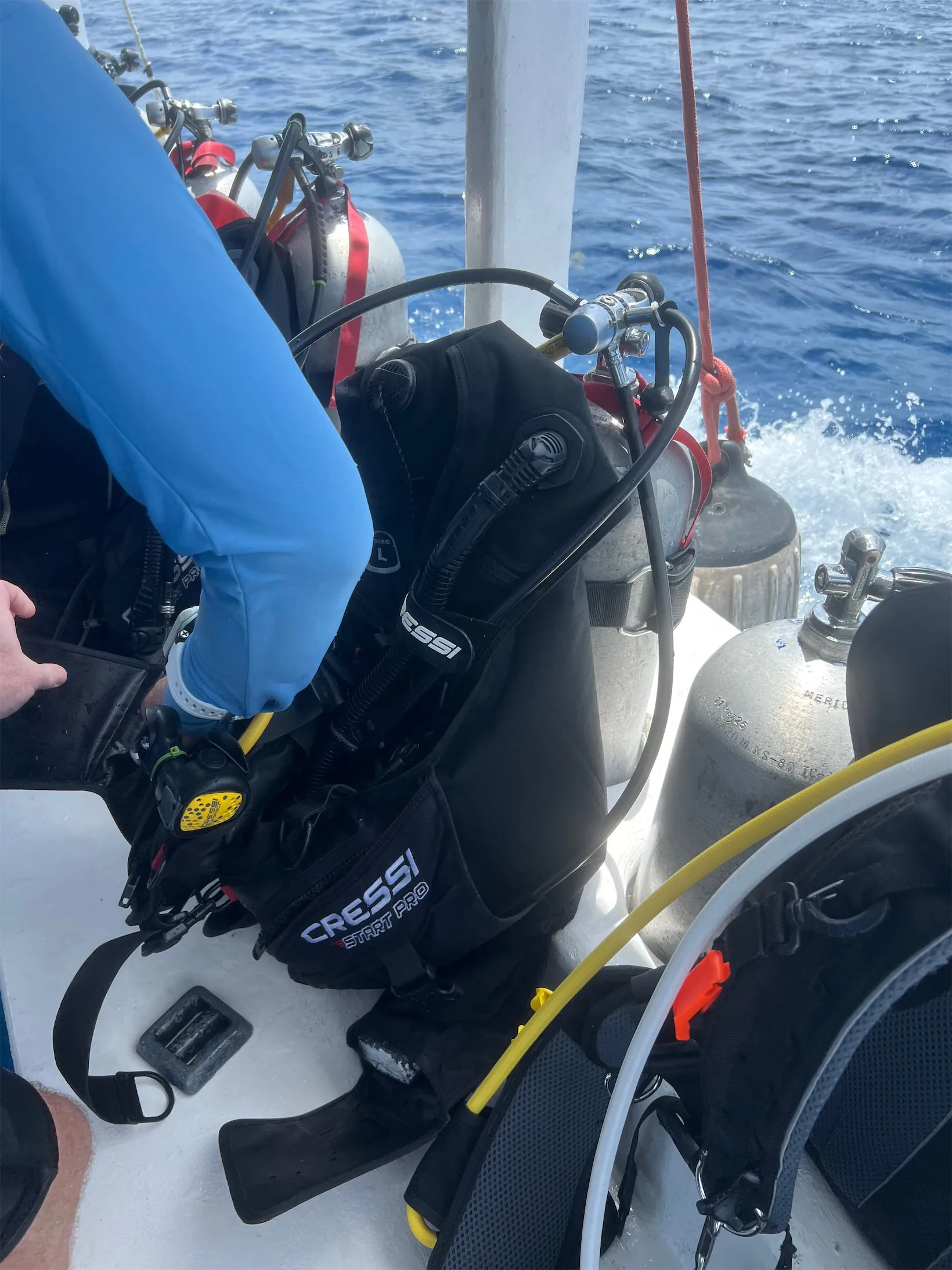
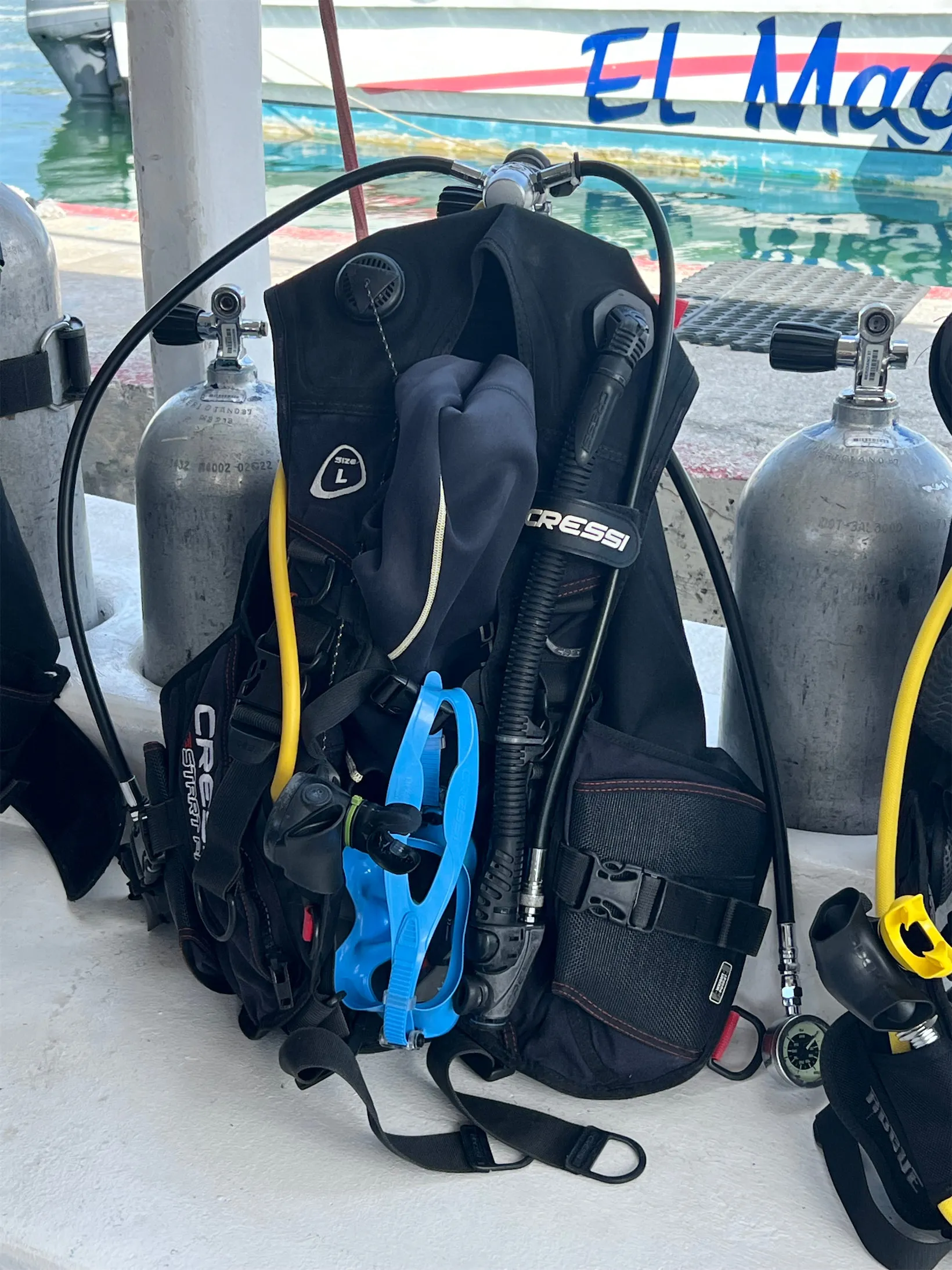
First dive spot was Paso del Cedral, about a 40-minute ride. My instructor briefed me on what to expect and we went back through what I’d learned on Day 1: hand signals, the reminder to breathe and equalize often, end-of-dive procedures. He told me I’d need to hold onto him while he inflated and shot the SMB (surface marker buoy, the inflatable signal device that floats to the surface to mark divers’ location for the boat) at the end, so the boat could find us.
I’d read something the night before about five Italian divers who’d gone missing in the Maldives, and another military diver who’d died searching for them. I wasn’t afraid going into Day 2, but I felt more respect. I was also a little worried about the mask issue. The previous day’s clearing practice hadn’t given me much confidence.
The crew gave us a ten-minute alert before the dive spot. Everyone got into wetsuits, did a final BWRAF check. I’m a checklist guy, so I enjoyed that part.
When we arrived, divers started going in one by one, big strides forward off the back of the boat. Before I jumped, I put a little air in the BCD, held my mask and regulator in place, and went. After hitting the water I inflated the BCD a bit more so I’d float comfortably while waiting for the descent signal. My mask fogged on entry, so I had to take it off, spit in it to prevent fogging again, rinse it, put it back on.
Signal that everything was OK. The instructor signaled to deflate and go down.
And at that moment, everything else stopped existing. I started descending slowly. No fear, no overthinking. Just being in the moment.
That feeling didn’t last long though, haha, because I quickly realized, through actual pain in my ears, that I’d forgotten to equalize at all. I signaled the instructor that something was wrong. He stopped, gave me time, and after proper equalization the pressure cleared. From that point on, I didn’t forget once. Every time I felt the slightest pressure shift, I equalized immediately and was fine.
To be honest, after Day 1 I’d still had a little pain in my right ear, and on the boat that morning I’d felt some discomfort in it from the wind. So I’d been worried about whether I could manage it at all. Turns out, even with some lingering soreness, it was just discomfort. Nothing unmanageable, nothing debilitating.
So my first real boat dive started. And almost immediately, as I was looking around, my rented mask started leaking water. Uh oh. The exact thing I’d been hoping wouldn’t happen.
I knew the steps for clearing the mask underwater. But I hadn’t really internalized them. I’m the kind of person who hates being taught one-on-one. I hate when someone shows me how to do something and then watches me try it. I need clear instructions, and then I need to figure it out myself, without being observed. So even though I’d done the mask-clearing drill in the pool, it hadn’t fully clicked.
At some point during the dive, the water got bad enough that I just had to do it. I pressed my fingers on the top of the mask, blew air out through my nose, and the water cleared. Easy. I was kind of surprised how easy it went. From that moment, the unease about clearing my mask disappeared completely. My mind was at ease.
The rest of the dive, I really started to enjoy myself. We saw three nurse sharks. Countless fish. Coral everywhere.
I was also surprised at how slow my breathing got down there. Long breath in, even slower breath out. I wanted to explore everything, especially the coral arches you could swim through, but the depth limit was 12 meters, and there was one more thing pulling at the edge of the experience: the instructor was holding me the entire time. That was really frustrating. I wanted to feel free, to enjoy. I did enjoy it, but the constant feeling of being held, or sometimes feeling badly balanced and realizing it was him pulling me from the side, wasn’t great.
I’d had the same frustration on the Day 1 shore dive. I’d thought it was a Day 1 thing. But no, same on the boat. I tried to let it go.
We spent 55 minutes down there. The instructor signaled me up when my air dropped to about 700 PSI. I held on as briefed, he shot the SMB to the surface, and we ascended slowly to 5 meters for our three-minute safety stop. Then up the rest of the way. I inflated my BCD at the surface and floated. The OW student from our group came up at the same time with her instructor. We waited together for our boat, Youcab 2, to come pick us up. Those 55 minutes had gone so quickly.
Getting back on board was easy. Half the divers were already there; the boat picked up the rest. Everyone re-attached their gear to fresh tanks and got comfortable.
The crew served lunch. Buns, ham, cheese, lettuce, a fish salad, a vegetable salad, two kinds of fruit. I picked a few pieces of fruit. It just felt wrong to see fish being served right after that peaceful encounter we’d had with the underwater world.
I felt awesome after the first dive. I finally understood why divers come to Cozumel from everywhere else.
For me, the experience slotted into three things I loved. First, the weightlessness, the ability to go down and just fly, no gravity. Second, exploring. It was so tempting to dive every cavity, swim through every arch, see what was around every corner. And third, the marine life itself. Watching those strange creatures in their natural habitat.
Haha, imagine those creatures were advanced enough to build the technology to come visit our world. Flying over our heads, walking our streets, observing us for an hour or so. Then heading back underwater for a quick human salad before another shift. But seriously, being that close to them was incredible.
The first shark I spotted was a sleeping nurse shark tucked under a reef. The instructor told me afterward it was still a baby, and that nurse sharks sleep about 20 hours a day. The second one we saw was much larger, swimming past. It’s amazing to see them that close. I admit I know almost nothing about the fish or the ecosystem, so I’ll learn as I dive more. The instructor told me nurse sharks are basically pet dogs of the reef: big, strong jaws designed for crushing prey, but unless you do something stupid like chase or corner them, they don’t care about divers at all.
At one point I also spotted a parrotfish pooping out white sand. I learned that parrotfish are the reason for those beautiful white Caribbean beaches. A small one produces around 90 kg (200 pounds) of sand a year. The bigger ones produce up to 450 kg (1000 pounds). That’s huge. We saw plenty of other fish I had no names for. Something to learn.
The hour-long surface interval went quickly. The crew let us know we were at the second dive spot and had about ten minutes before going down. Everyone started prepping. I noticed an older diver who’d seemed shaky after the first dive, and then I saw him vomiting over the side during lunch. Not a great visual during a meal, but what can you do. He sat the second dive out.
For our second dive, we did BWRAF again and I felt much more confident this time. I knew what to expect.
The second spot was Tormentos. It’s known for drift diving: you don’t really swim, the current carries you through. And I got that experience fully. The drift was strong. It felt like flying over coral structures. Pretty amazing.
This time we saw another big nurse shark, a large swimming loggerhead turtle, a sleeping green sea turtle, squid, great barracudas, a stingray, and plenty I couldn’t name.
A few negatives from this second dive though. First, the boat crew had misread the currents. I was told later they dropped us at the wrong spot for the conditions. So we only got to experience part of Tormentos. The current pushed us in a direction that took us through the coral structures and then out into deep blue, with just sandy and grassy bottom. I still had plenty of air, but I had to follow the instructor.
The other negative was that, with the current as strong as it was, the constant pulling from the instructor was even more pronounced. It felt restrictive, the opposite of what diving should feel like.
After we surfaced, we floated for about fifteen minutes waiting for the boat. Getting back on board was easy. We packed up our gear, peeled out of the wetsuits, and got comfortable. The boat picked up the rest of the divers along the way.
My instructor said something that felt good to hear: that I’m a natural underwater. He was also impressed that, at my size (I’m 1.9m / 6’2”), I’d managed a 55-minute first boat dive and still ended with spare air. He told me his own air consumption as a beginner was much higher, and that efficient consumption was a skill he developed much later.
The ride back to port was a relaxing, sunny, warm Caribbean afternoon. After docking, we rode the school van back. We were at the dive school by about 3pm. The whole Day 2 experience was about six and a half hours, door to door.
Once back, I asked my instructor how to log my dives. He recommended the official PADI app, so I downloaded it, logged in, and added all three dives manually: the 27-minute DSD shore dive from Day 1, plus the two boat dives from Day 2, which he verified. So as of that evening: three dives, three different spots in Cozumel, 129 minutes underwater.
Overall, DSD did its job. My body tolerates diving, and I genuinely enjoyed it. That night, lying in bed, I just wanted to go back down. That’s a sign.
What I Actually Wondered About (and What Turned Out to Matter)
I love sci-fi. Books, movies, the worldbuilding, the tech, the exploration. But would I actually go to space if I had the chance? Most people I ask say yes immediately. Me? Nah. Too many unknowns I can’t control. If something goes wrong up there, you don’t get a do-over. I’m not a fearful person, I’ve done plenty of stupid stuff in my life. It’s not about danger. It’s about what I can manage and what I can’t.
Diving sat in the same mental category for years. The water world has its own aliens, its own life-support requirement, its own things-that-could-go-wrong. So why bother? That’s how I avoided diving for the entire time I’ve lived in Cozumel.
When I finally booked the DSD, I had a handful of specific concerns. Nothing paralyzing. Just the questions a thinking adult has about doing something new in a hostile environment. Three were concrete and physical, and one was more abstract.
My Ears or Sinuses Might Not Tolerate the Pressure
Years ago I tried freediving while goofing around in open water and my forehead hurt intensely. I think my sinuses were congested at the time, but I can still feel that pain when I think about it. What if my ears were just sensitive? Snorkeling and dropping two or three meters for a few seconds is one thing. What about 12 meters? 20? 30? I was seriously considering taking decongestant pills before Day 2.
On my very first descent on the boat dive, I forgot to equalize at all and felt real pain in my ears within seconds. I signaled the instructor, he stopped, I equalized properly, and the pressure cleared. From that point on I equalized constantly and was fine for both 55-minute dives. I had some lingering soreness in my right ear from Day 1, plus discomfort from wind on the boat that morning, but underwater it was manageable. My ears handled it. The freediving forehead pain didn’t reappear.
So: the concern was real, the pain on the first descent was real, and the resolution was a procedural one. Equalize properly, equalize often. The question was about whether my body could do the thing. It can.
I Might Lose It When Water Gets in My Mask
Mask clearing was the only skill from the pool session that I didn’t enjoy at all. Breathing through my mouth and then forcing air out my nose, water around my eyes, the whole sequence felt panicky in a way the rest of the pool session didn’t. I went into Day 2 specifically uneasy about this one. I’m the kind of person who needs to figure things out on my own, without being observed, and the pool drill hadn’t given me that.
My rented mask did leak on the boat dive. The exact scenario I’d worried about. When the water got bad enough, I pressed the top of the mask, blew air out through my nose, and the water cleared. It was easy. From that moment, the unease about mask clearing disappeared completely.
The panic I’d anticipated never showed up, because by the time the situation actually arrived I was busy solving it instead of dreading it. That gap, the gap between rehearsing a procedure and actually needing it, turned out to be the thing I’d been bothered by. Not the water.
What If We Encounter a Real Shark
I knew Cozumel has sharks. What I didn’t know was how I’d react. Would I panic? Would I keep my composure? I genuinely had no idea, and I’d read enough to know that what you do in the first second matters.
I saw nurse sharks on both boat dives, including one swimming past at close range. Nurse sharks are essentially the pet dogs of the reef. Big jaws, but unless you chase or corner them, they don’t care about divers. So I didn’t get a real test. The honest answer is: the question that mattered, encountering something that actually requires composure, wasn’t tested by my DSD.
What I went in with was knowledge. Don’t act like prey. Don’t kick, don’t panic, don’t try to swim away fast. Stay calm, look like a fellow predator. Would I manage that in a real moment? I don’t know. But going underwater with that knowledge already in my head felt like the right kind of preparation. Knowing the right thing to do doesn’t guarantee I’d do it. It just shifts the odds.
That’s the most honest version of the answer I can give. The DSD confirmed my body can handle diving. It didn’t confirm my nervous system can handle a real predator encounter. Those are different tests, and only one of them happened.
And Then the Bigger One: What If Something Just Goes Wrong
The three concerns above were specific. Underneath them was a more abstract one that bothered me more than any of them individually. What if my equipment fails? What if I suddenly lose all my air? What if something happens down there and no one notices I need help?
The what ifs. The category every beginner has and almost no DSD article actually addresses.
What I learned, both from the eLearning and on the dives themselves, is that the what ifs aren’t unsolved problems. They’re problems that diving has been solving for decades, and every one of those solutions is built into the standard procedures.
That’s why regulators have two separate hoses with two mouthpieces. If one fails, you breathe from the other. That’s why divers operate in a buddy system, so if something goes wrong with your primary and your backup, there’s another diver close enough to share their air with you through their second mouthpiece. That’s why there are pre-dive equipment checks like BWRAF, run every single time before every single dive, so equipment failures get caught on the surface instead of at 12 meters. The mandatory safety stops at 5 meters before surfacing are there to let dissolved nitrogen leave your body safely. Same logic behind dive tables, depth limits, ratio limits, and certification requirements.
None of these procedures exist because somebody invented them in a meeting. They exist because something went wrong in the past and someone figured out how to keep it from happening again. The whole structure of diving discipline is a record of accidents that didn’t get to happen twice.
Once I understood that, the what ifs got a lot quieter. The questions don’t go away. But each one has an answer, and the way you get from worried to capable is just learning the procedures and taking them seriously.
This was the thing nobody told me beforehand, and it’s the thing I want to tell other people considering their first dive. The reason your what ifs feel paralyzing is that you don’t yet know the answers. Once you do, they’re not paralyzing. They’re just things to keep practicing.
What I Learned
The reality of diving turned out to be more manageable than the way I’d been thinking about it. That’s almost always true of unfamiliar things, but it’s especially true here. The standard don’t worry, it’s safe line didn’t do anything for me. What changed things was knowing the specific questions had specific answers, and seeing where those answers came from.
Scuba diving is not rocket science. It’s not even hard. The thing you need to overcome is the feeling that the unknowns are unsolved. They’re not.
Compliance: What PADI Requires, What My Shop Did, Where I Saw a Gap
One last thing worth being specific about: whether my shop actually followed the rules. What follows is the PADI standard for Discover Scuba Diving, what Cozumel Dive School actually did on each requirement, and where I observed gaps between standard and practice. The standards are public; I checked them on PADI’s published materials after the fact.
The PADI Discover Scuba Diving Standards
| Requirement | PADI standard | What Cozumel Dive School did |
|---|---|---|
| Minimum age | 10 years (no upper age limit) | Verified at booking |
| Maximum depth, open water | 12 meters (40 feet) | Briefed and followed; both my boat dives stayed within limit |
| Maximum depth, pool/confined water | 6 meters (20 feet) | School pool was approximately 1.5m, well within limit |
| Maximum students per instructor, open water | 4:1 (6:1 with certified assistant) | I had 1:1 because no other DSD student that day |
| Medical screening | PADI Medical Form required; doctor’s statement if any condition disclosed | Medical Form submitted during eLearning. Doctor’s note required if you mark Yes to any condition or if you’re over 45. |
| Swim test | Not required for DSD (OW requires 200m swim + 10-min float) | No swim test for me; saw an OW student doing pool laps that morning |
| eLearning/theory | Briefing required covering basic safety, hand signals, gear, equalization | PADI eLearning DSD course completed before arrival; 9-question knowledge check |
| Liability paperwork | Standard release + medical form | Equipment rental agreement + Liability Release signed on Day 1 |
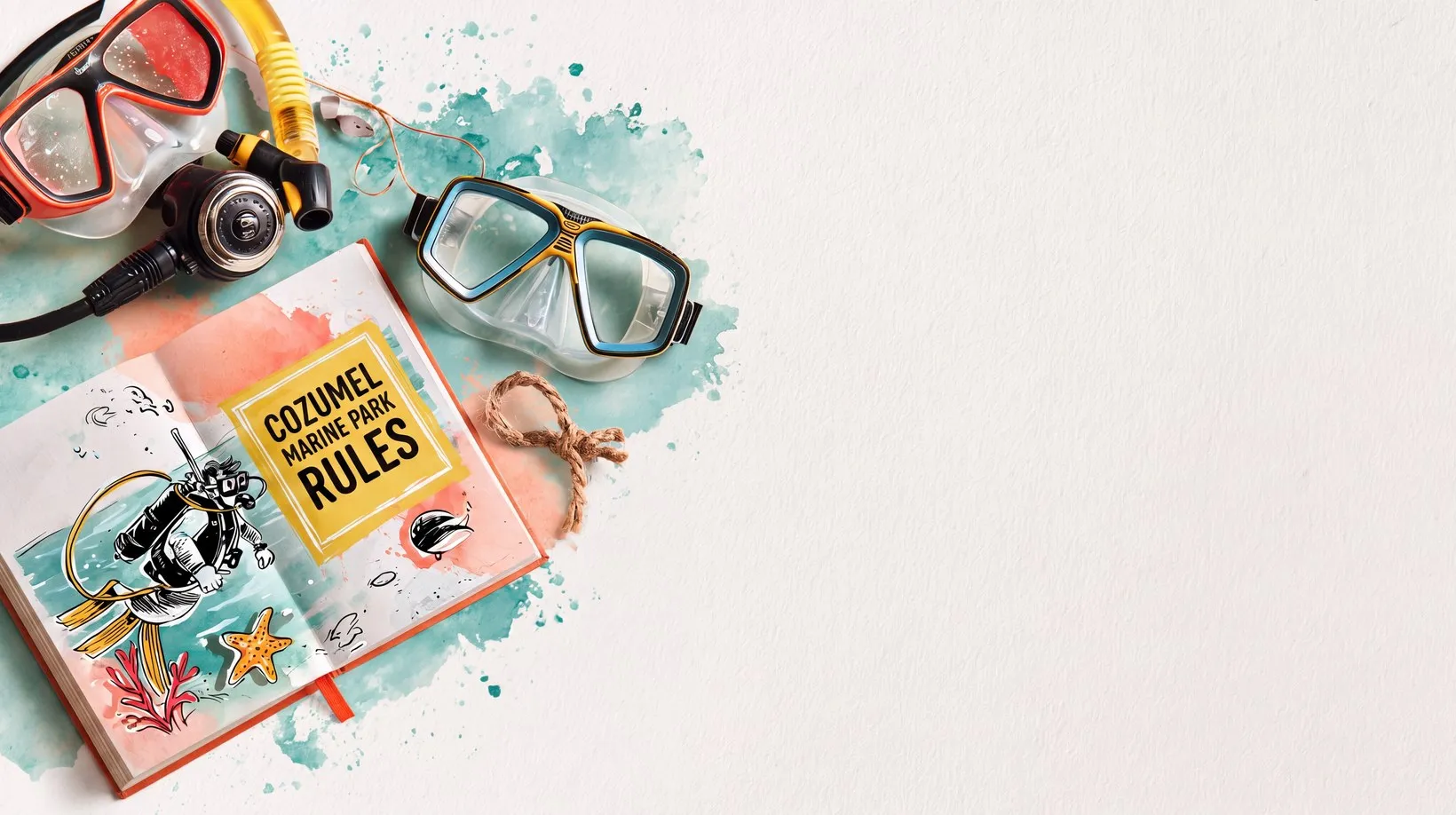
| Environmental briefing | Required: don’t touch the reef, don’t feed marine life, no sunscreen | PDF sent at booking covering Cozumel Marine Park rules; verbally reinforced at briefing |
| Cameras during the dive | Instructor must not take photos or video while supervising participants (PADI publishes no rule on participants carrying cameras) | Instructor didn’t shoot; I chose to leave my GoPro topside |
| Instructor physical contact | Must keep DSD students in close proximity and ready to physically intervene | Constant physical contact for both boat dives. Gap between standard and practice. |
The Leash Gap
On all three of my dives, the shore dive on Day 1 and both boat dives on Day 2, my instructor physically held me for almost the entire duration. Not during the descent itself, but from the moment we reached depth until we began ascending. Between the two boat dives, during lunch, I asked him about it. He told me it was the rule, that DSD students have to be held.
I checked PADI’s published standards afterward. PADI’s own wording is to “position yourself so that you or a certified assistant can make immediate physical contact with, adjust buoyancy for, and render assistance to” participants, and to not leave them unattended. That is a standard about being positioned to intervene immediately, not about holding the student for the entire dive. Constant physical contact is not the standard.
If a hands-on supervision style matters to you in either direction, ask the shop directly before booking, and ask the instructor again on the day. The question is: Will the instructor be in physical contact with me throughout the dive, or only ready to intervene if needed?
Other than this one gap, my shop met the PADI standards as best I could verify. Medical screening was handled through the PADI eLearning Medical Form. Liability paperwork was complete. The ratio was well under the 4:1 maximum. Depth limits were respected. The pool/confined-water session happened on Day 1, before the open-water dives. Environmental rules for the Cozumel Marine Park were sent as a PDF at booking time.
Frequently Asked Questions About Discover Scuba in Cozumel
What is the Discover Scuba experience actually like?
It’s a structured introduction to real scuba diving over either one or two days, depending on the shop’s format. My version was a 2-day Extended program: a pool session and a shore dive on Day 1, then two boat dives on Day 2. Three dives total, 129 minutes underwater, maximum depth 12 meters. You don’t earn a certification, but you experience real diving with a real tank, a real regulator, and a real reef.
Will I panic underwater on my first dive?
Probably not, and the reason is procedural rather than emotional. The panic-inducing moments most beginners worry about (water in the mask, ear pressure, equipment confusion) all have specific, learnable responses the instructor walks you through before you enter the water. In my own case, the mask-clearing drill that felt panicky in the pool resolved itself underwater because I was busy solving it instead of dreading it.
How long does Discover Scuba last?
Most shops in Cozumel sell DSD as a single day, ranging from about 4 hours (the rushed end: pool plus one boat dive, or two boat dives back-to-back) to 6 hours (the more relaxed end: pool plus one boat dive with proper briefing time). The shop I went with offered a less common 2-day Extended version, splitting a pool/shore-dive day from a two-boat-dive day at roughly 6-7 hours per day.
How safe is DSD for someone who has never dived?
Reasonably safe, because the structure of the program is built around the assumption that you’ve never done this before. You’re capped at 12 meters maximum depth, you breathe from a regulator with a built-in backup, your instructor stays close enough to intervene, and you’ve already passed a basic medical screening before the day starts. Every safety procedure exists because something went wrong in the past and someone built a response. None of that eliminates risk, but it does mean a first-timer is operating inside a system that was designed for first-timers.
Can I bring a camera or GoPro on a Discover Scuba dive?
PADI prohibits the instructor from taking photos or video while supervising a DSD, because their attention has to stay on you the whole time. There is no published PADI rule about participants carrying their own camera, though in practice plenty of shops won’t allow it, so ask yours.
I had a GoPro and chose to leave it on the boat anyway. On my first open-water dives my hands were full just breathing, equalizing, and watching my buoyancy, and fiddling with a camera felt like a good way to miss the actual dive.
No footage of me underwater, but I was present for all of it, and I would make the same call again.
Do you need to know how to swim to do Discover Scuba?
No, swimming isn’t a formal requirement for Discover Scuba. The PADI standard for DSD doesn’t include a swim test, and my Cozumel shop didn’t ask me to do one either, though the same shop’s Open Water students were doing pool laps that morning for their certification.
That said, my honest opinion is you should at least be comfortable enough in the water to float without panicking.
Imagine doing a “Discover Rally Driving” day. They give you the helmet, the suit, the briefing, the co-driver explaining stage notes. Then you sit down in the car and realize it’s a manual transmission and you’ve never driven a stick. The instructor next to you can help, but you’re going to spend the whole day fighting the basics instead of enjoying the speed.
Scuba’s the same. If you can float and breathe slowly through a regulator without it being a crisis, you’ll have a real first dive. If you can’t, you’ll have a managed crisis instead.
What is the maximum depth for Discover Scuba?
The maximum depth for Discover Scuba is 12 meters (40 feet) for the open-water portion, and 6 meters (20 feet) for the pool or confined-water portion. My own dives went to 8 meters on the shore dive and 12 meters on the boat dives, and honestly the depth limit didn’t matter the way I expected it to. At 8 meters I was already up close to the coral and the fish. At 12 meters I was getting the full experience of what scuba diving feels like.
The places I actually felt pulled to go deeper were the swim-through arches and reef cavities I could see below me, not deeper water in general. That kind of exploration is what Open Water certification opens up, and it’s a good reason to keep going after Discover Scuba.
What’s the minimum age for Discover Scuba Diving?
The minimum age for PADI Discover Scuba is 10 years old, with no upper age limit set by the standard.
One observation from my own experience worth passing along: you hold a regulator mouthpiece between your teeth for the full duration of every dive, lightly biting down on the rubber to keep it in your mouth. By the end of my first 55-minute boat dive my jaw was tired.
I don’t have any dental issues, so it was fine, but it made me think that anyone with significant dental work or jaw sensitivity might want to factor that in. The standards don’t address it, but neither do most operator pages, and I noticed it.
Do I need to be certified to do Discover Scuba?
No, you don’t need any certification or prior experience to do Discover Scuba. That’s the whole point of the program: it’s designed for people who’ve never dived before and aren’t sure they want to commit to a multi-day certification course.
I knew effectively nothing about scuba diving going in, and the structure of the experience handled that. The instructor walks you through everything, the depth is capped at 12 meters, and a PADI Pro is in physical proximity to you for the entire underwater portion.
If you’re still weighing whether you even need to certify at all, that’s a separate decision, and I work through it in scuba diving without certification.
Is Discover Scuba worth it?
Yes, and I’m glad I did it before committing to Open Water certification. Two reasons.
First, I confirmed my body actually tolerates diving without spending $500+ on a full course and discovering halfway through that I hated it. The DSD surfaced that answer cheaply.
Second, I now know what diving actually feels like, which means my eventual OW course will be about learning skills instead of also managing first-time-underwater nerves.
I’ve read posts from newly certified divers asking how to breathe through their mouth, or saying they’re still panicking on mask clearing despite being certified. Doing those skills for the first time in a stressful certification setting, rather than for the first time on a low-stakes DSD, seems like a harder path.
Discover Scuba is a $200 calibration step before a $500 commitment. For me it was worth it.
Closing Reflection
I lived in Cozumel for years and didn’t dive. Then in two days I did three dives and understood why people fly here for a week to spend it underwater. The thing that made the difference wasn’t a revelation about the reef. It was the procedure. Once I understood that the what ifs had answers, and that the answers had been built into the standard operating practice for decades, the whole thing got smaller. Manageable. The DSD did exactly what it’s meant to do: it surfaced answers cheaply. Two days, three dives, body tolerates it, mind enjoys it. If I’d hated it, that would have been a legitimate answer too.
What I haven’t decided is which shop to do my OW with. There are 300 dive operators in Cozumel and I’d rather take another week to talk to a few more before committing to a 3-4 day course. The post-DSD discount at Cozumel Dive School is on the table, but a $40 discount isn’t enough to make the decision for me.
If you want the full picture of diving the island, start with the complete guide to diving Cozumel. If you’re trying to figure out whether you even need to certify, that’s a separate question and I’ve written it up in scuba diving without certification. If you’re trying to figure out which shop to go with, that’s the harder one, and the framework I’m working through is in how to choose a Cozumel dive shop.
Last verified: August 2026. I update this page if anything changes, the shop, the standards, or my own perspective.
A reminder on what this article is: my own first DSD experience, written as reasoning and provenance. Cozumel Dive School is named because it’s the shop I dived with.
More on DripDive: Scuba Diving in Cozumel: The Complete Guide, Best Time to Dive Cozumel: When to Go, Can You Scuba Dive Without Certification in Cozumel?, and Cozumel Diving Conditions by Month: Water Temperature, Visibility & Currents