
Cozumel is the best easy diving in the world. The island sits off the Caribbean coast of Mexico, and scuba diving here is what put it on the map. The water is warm, 79 to 85 degrees Fahrenheit (26 to 29°C) year round. Visibility runs 80 to 100 feet (24 to 30 m) on an ordinary day.
The reef sits inside a protected national marine park, which is why it is still alive and still worth the trip. And the current does most of the swimming for you. You can dive here any day of the year, and you do not need a certification to start.
Drop in, and you are carried weightless along a wall of living coral, a sea turtle grazing an arm’s length away. On Cozumel, that is an ordinary morning.
Cozumel is also the easiest place in the world to waste a dive trip. Same island, same reefs, wildly different days. The difference is not luck. It is a handful of decisions you make before you ever get in the water: who you dive with, when you come, and whether you understand the current.
Get them right and you will see why people cross the planet to spend a week underwater here. Get them wrong and you will pay full price to be herded off a crowded boat through a dive you barely remember.
This guide is how to get them right. Where I name a dive operator, it is because I dived with them or asked around about them. But before the how, the why.
Quick facts
- Best time
- Nov or May
- clearest water Dec–May
- Water temp
- 79–85°F26–29°C
- year-round
- Visibility
- 80–100+ ft24–30+ m
- on an ordinary day
- Wetsuit
- 3 mm
- shorty or rashguard in summer
- Dive sites
- 20–130 ft6–40 m
- beginner to advanced, all drift
- Marine life
- Splendid toadfish
- the island's signature fish; plus turtles, eagle rays, sharks & many more
- Skill level
- None needed
- gentle drift; Discover Scuba, no cert
- Typical cost
- $120–145/day
- all-in, before gear & tips
- Marine park
- Protected since 1996
- no fishing or anchoring; why the reef thrives
- Night diving
- Paradise Reef
- the classic site; the toadfish hunts after dark
- Liveaboards
- None
- all diving is from day boats
- Getting there
- Fly to CZM
- or via Cancun → Playa del Carmen → ferry (~45 min)
Two things the facts above don’t tell you:
- Who you dive with matters more than where you dive. Book a small-group, steel-tank operator and you get roughly 50% more time underwater for a little more money.
- It is a drift dive. You do not need to be a strong swimmer, just a calm one. The current does the work.
Why Cozumel is one of the best dives on earth
Cozumel is not just a good place to dive. It is one of the great ones, and it earns that the hard way, not through marketing. Here is what puts it there.
The reef, the current, and the wall
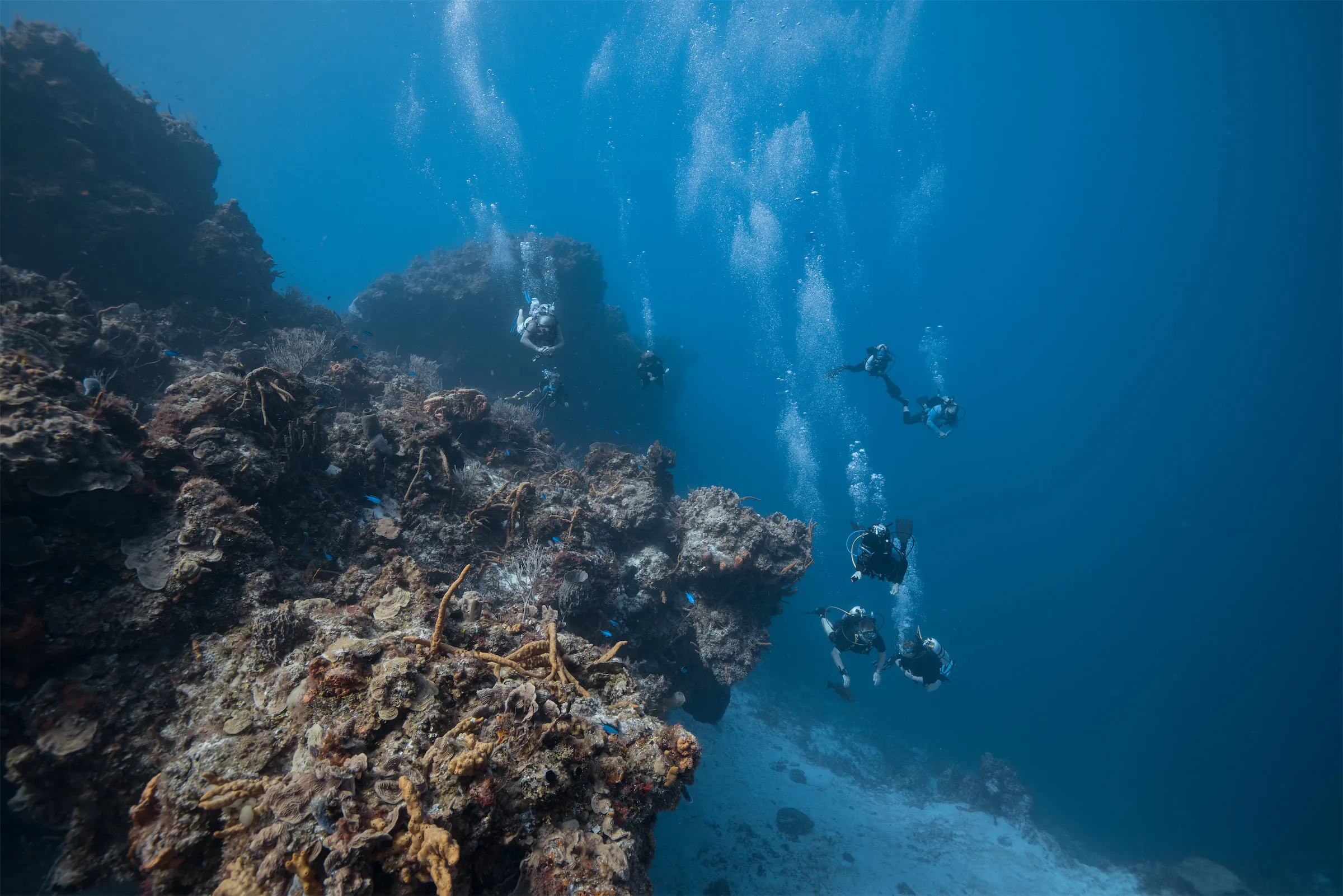
The reefs you will dive are the northern tip of the Mesoamerican Barrier Reef, the second-largest reef system on the planet. Only Australia’s Great Barrier Reef is bigger. It runs for some 700 miles (1,100 km) down the Caribbean coast, from the Yucatan through Belize and Guatemala to Honduras, and it is the largest reef in the Western Hemisphere. Cozumel sits near its northern tip.
What sets the diving here apart is the current. Cozumel is an island, cut off from the mainland by a deep channel, and that channel drives a steady current from south to north along the island’s west coast, where all the diving happens. It carries you along the reef with almost no effort, which is the famous drift, and it keeps the water remarkably clear.
The reef itself is not a flat garden. It is architecture. The coral builds into towering pinnacles, archways, and tunnels you can swim through, and along the famous walls it drops straight off the edge of the shelf into deep blue water that fades to black below you. You are not just looking at a reef. You are floating along the face of an underwater cliff, open blue on one side and living coral on the other.
Protected, and why it stays special
And it stays this beautiful because it is protected. The reefs have been a national marine park since 1996, off limits to fishing and anchoring, which is a big part of why they remain healthy while so many Caribbean reefs have declined.
Its edge is not one headline animal or one famous site. It is the experience itself: a forgiving drift that does the work for you, in warm, clear water, on nearly any day of the year. Ask divers who have been everywhere what makes Cozumel special, and most do not start with what they saw. They start with how it felt.
The Cousteau myth, corrected
One myth worth clearing up. You will read everywhere that Jacques Cousteau put Cozumel on the map with an underwater documentary in the early 1960s. He did not, and the Cousteau Society itself has said no such film was ever made.
What actually drew the world here was a Mexican underwater movie shot at Cozumel in 1956, called “Un Mundo Nuevo,” and a 1958 magazine article that reached millions of American readers. The proof is on the dive map: there is a reef named for that film’s director, Cardona, and none named for Cousteau.
Cousteau did dive here later and loved it, and there is even a statue of him on the seabed today. But Cozumel made its own name, on the strength of the diving itself.
What lives down there
A reef is only as good as what lives on it, and this is where Cozumel stops being merely beautiful and becomes one of a kind.
The splendid toadfish, found almost nowhere else
Start with the fish you will not find on other Caribbean reefs: the splendid toadfish. Every dive shop on the island calls it endemic to Cozumel. That is the shorthand, and it is worth correcting: the species has also been recorded at Glover’s Reef in Belize, with scattered reports from the coast between there and Cancún. What stays true is the part that matters to you. Cozumel is where divers reliably see one, and it is worth wanting.
Picture a zebra-striped, flat-headed fish about the length of your forearm, with bright yellow edges on its fins and a fringe of little whiskers along its chin like a beard. It spends its days wedged under a ledge with only its face showing, grumpy and unbothered, and at night it comes out to hunt and to “sing,” a low croak it makes to attract a mate.
You do not stumble onto one. You find it by slowing down, dropping low over the sand where the reef meets the bottom, and peering under the overhangs, which happens to be exactly the kind of diving Cozumel rewards. Tell your guide you want to see one. The good ones know where they live.
Turtles, sharks, and the everyday cast
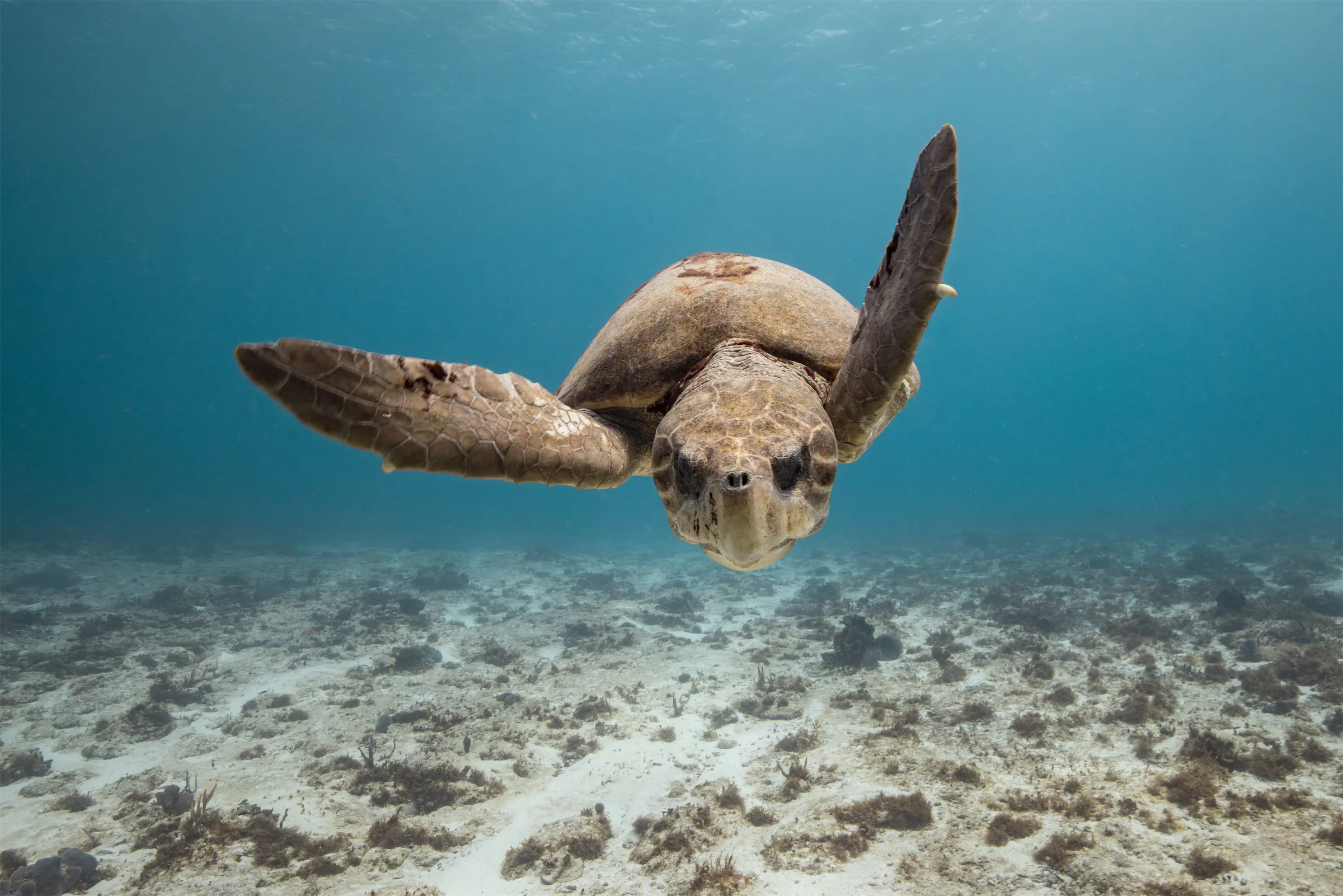
The animal you are all but guaranteed to see is the sea turtle. They are so common here that your divemaster will probably stop pointing them out partway through the trip. Most are hawksbills, the reef specialists, with a narrow pointed beak built for pulling sponges out of the coral, which keeps them on the reef right where you will run into them.
The rounder, blunt-headed ones are green turtles, which graze the seagrass and sleep for hours on the bottom with their heart rate slowed almost to nothing. Both are so used to divers that they will let you drift alongside, close enough to watch a hawksbill calmly demolish a sponge without sparing you a glance.
Then there is the everyday cast, the animals you will see on most dives without trying. Nurse sharks doze under ledges and inside swim-throughs, harmless and entirely uninterested in you. Green moray eels, some as thick as your leg, breathe from holes in the coral with their mouths hanging open. Big groupers hang in the blue. And the reef hums with schooling fish: silver clouds of grunts and snappers, schools of porkfish, pairs of bright queen angelfish, and now and then a wall of barracuda hanging motionless in the current.
The small stuff, and 400-year-old sponges
The reward for diving slowly is the small stuff most people swim right past. Seahorses hooked onto sea fans. Octopus rolling through colors as they move across the reef. Tiny arrow crabs tucked deep inside the barrel sponges. Lobster antennae poking from a crevice. There is wonderful macro diving here, but only if you slow down enough to find it.
And the reef itself is alive in a way photographs never quite capture. Cozumel is famous for its sponges, and not the small kind. Giant barrel sponges grow four and five feet across, big enough to climb inside, and the largest are estimated at three to four hundred years old, which means you are finning past living things that were here before the island had its name. Add the orange and purple tube sponges and the coral towers, and the wall stops being a backdrop. It becomes the main event.
The big seasonal visitors, the winter squadrons of spotted eagle rays and the animals that draw their own crowds, are covered in the when-to-go section below, because seeing them is a matter of timing. But you do not need to time anything for the turtles, the toadfish, the sharks, and the rest. They are here every single day of the year. That is the quiet luxury of diving Cozumel: you do not have to get lucky. You just have to get in the water.
Every animal here, from the toadfish to the turtles and sharks, gets a full species-by-species guide in the Cozumel marine life guide.
It’s a drift. You don’t need to be strong, you need to be calm.
Almost every dive in Cozumel is a drift dive, and once you understand what that means, the whole place makes sense.
How a drift dive works
Here is how it works. A current runs along Cozumel’s west coast, where all the diving happens, and it almost always flows in one direction, from south to north. Your boat drops you in at the south end of a reef. You sink down, and instead of swimming anywhere, you let the current carry you north along the wall. The captain watches for your bubbles and picks you up wherever you surface.
You are not swimming the reef. You are flying over it.
You need to be calm, not strong
This is the part that scares new divers, and it should not. You do not need to be a strong swimmer or a hundred-dive veteran to dive Cozumel. You need to be a calm one. The current is not something you fight, it is something you relax into, and the work is done for you.
On the gentle reefs, where almost everyone starts, the drift is slow and forgiving and your guide handles the navigation. Your only job is to breathe slowly, stay off the coral, and look around.
Not every site is gentle, though. The reefs at the far north end of the island run a fast, strong current, sometimes three knots or more, and those are for experienced divers only.
But you do not choose your own sites here, your operator does, based on the conditions that day and your experience level. A good one will never drop a nervous beginner onto a ripping drift. That is one more reason the operator you pick matters more than almost anything else, which gets its own section below.
Why the water is so clear
The clear water has a cause worth knowing. Cozumel is flat limestone with no rivers, so nothing muddies the sea, and the current constantly sweeps clean ocean water across the reef and carries any particles away. That is the famous visibility, better still in winter. One caveat, though: operators will advertise 150 or even 200 feet (46 to 60 m), so treat that as a great day, not a promise.
What the drift feels like
I did not understand any of this until I did it. I had lived in Cozumel for years without diving once, and on one of my first real dives, on a reef called Tormentos, the current was strong enough that I felt like I was flying. I stopped kicking and just went, weightless, a few feet over the coral, watching it scroll past underneath me.
Somewhere in the middle of that dive I finally understood what brings divers here. It was not the fish, though there were plenty. It was the feeling of the water carrying me. That is the thing Cozumel has that most places do not, and it is the reason the rest of this guide is worth reading: so you get it, instead of paying for it and missing it.
The drift is Cozumel’s signature, but it is not the only way to dive the island. Night, shore, and specialty diving each get their own guide.
Who you dive with matters more than where you dive
If you get one decision right in Cozumel, make it this one. The reef is the reef. The crew you book is what turns a great day into a forgettable one.
The short version: the cheap and easy options are usually big boats that put as many divers in the water as the rules allow and give everyone a fast 45-minute dive. The better operators run small groups, six divers or fewer per guide, and use big steel tanks that hold more air than the smaller aluminum ones most boats carry.
That last part is the whole game. More air means longer dives, so two dives with a small-group operator can put you underwater as long as three dives on a cheaper boat. Same day, a little more money, and roughly 50% more time in the water.
So book the small-group operator. Unless you are chasing maximum comfort or hauling a big camera, that extra bottom time is the easiest upgrade in the sport.
I put the full breakdown on its own page so this stays short: how the two kinds of operator really differ, the five questions that sort a good one from a bad one, and what a two-tank dive costs once the fees they leave off the headline price get added back in. The full guide to choosing a Cozumel dive shop is a separate page.
When to go, and what you will see each month
There is no bad month to dive Cozumel. The water never drops below the high 70s°F (mid-20s°C), and even a slow visibility day here is 80 feet (24 m). But they differ more than you would think, and one of them is the right one for you. It comes down to what you are optimizing for: the clearest water, the biggest animals, the smallest crowds, or the lowest price. You usually cannot have all four at once.
The quick version
- Clearest water and the calmest, easiest diving: December through May. This is the dry season. Visibility is at its best, often past 100 feet (30 m), and the water is glassy. It is also the busiest and most expensive stretch, especially around the holidays and spring break.
- Warmest water: July through September, topping out around 85 degrees Fahrenheit (29°C). Bath-warm. This is also peak hurricane season, so you are trading some weather risk for the warmth and the low prices.
- The sweet spots: May and November. Shoulder months that give you most of the dry-season clarity, warm water, thinner crowds, and lower prices, before the holiday and storm extremes set in. If you have no specific reason to pick another month, pick one of these.
- Cheapest and quietest: September and October. The fewest divers and the lowest prices of the year, because it is also the wettest and the highest storm risk. A real option if you are flexible and do not mind the gamble.
| Month | Water | Visibility | Crowds & price | What's notable |
|---|---|---|---|---|
| January | 79°F26°C | Excellent, 100+ ftExcellent, 30+ m | Very high | Eagle rays; clearest water |
| February | 79°F26°C | Excellent, 100+ ftExcellent, 30+ m | High | Coolest, clearest water of the year |
| March | 80°F27°C | Excellent, 100+ ftExcellent, 30+ m | Very high | Spring-break crowds; superb clarity |
| April | 81°F27°C | Excellent, 100+ ftExcellent, 30+ m | High | Calm and warming; great all-around |
| May | 82°F28°C | Very good, 90+ ftVery good, 27+ m | Moderate | Sweet spot; whale-shark season opens (off Isla Mujeres) |
| June | 83°F28°C | Good, 80+ ftGood, 24+ m | Low | Warm, quiet, cheap; hurricane season opens |
| July | 84°F29°C | Good, 80+ ftGood, 24+ m | Low | Warm water, thinner crowds |
| August | 85°F29°C | Good, 80+ ftGood, 24+ m | Low | Warmest water; quietest reefs |
| September | 85°F29°C | Variable | Lowest | Warmest and cheapest; peak storm risk |
| October | 84°F29°C | Good, 80+ ftGood, 24+ m | Low | Quiet and cheap; some weather |
| November | 82°F28°C | Very good, 90+ ftVery good, 27+ m | Moderate | Sweet spot; eagle-ray season begins |
| December | 81°F27°C | Excellent, 100+ ftExcellent, 30+ m | High | Clarity returns; holiday crowds |
A few things the table cannot show you
The water is warm, but bring a little neoprene anyway. Most of the year a 3 millimeter wetsuit is right. In the warmest summer months plenty of divers drop to a shorty or just a rash guard. If you get cold easily, bring the 3 millimeter year round, because even in summer the second dive of the day can give you a chill.
The current is gentle most of the year and livelier in winter. Through the summer the drift is usually slow and calm. In the winter it picks up to moderate, which experienced divers enjoy and beginners barely notice on the southern reefs. Either way, your operator picks sites to match the conditions and your level.
What you’ll see, season by season
The animals are what most people are really asking about. Cozumel has resident turtles, nurse sharks, and eagle rays all year. But three encounters are seasonal and worth planning around:
- Spotted eagle rays gather in big numbers from December through February, sometimes a dozen or more cruising the same stretch of wall. The southern reefs are the place, and it is one of the real spectacles of the winter.
- Bull sharks are a winter visitor to the region, roughly November through March. One heads-up: the dependable bull-shark dive is not in Cozumel. It runs off Playa del Carmen, a 35-minute ferry across to the mainland, and most operators want you Advanced-certified for it. You might spot the occasional bull shark off Cozumel’s own south end in winter, but if diving with them is the point, plan the mainland trip.
- Whale sharks are the big one people ask about, and they are a summer event, roughly late May through August. The catch: they gather off Isla Mujeres, not Cozumel, so it is a day trip from the island, and it is a snorkel alongside them, not a scuba dive. Worth knowing before you book a summer trip expecting to dive with them here.
Weather, storms, and sargassum
One warning about the weather. Hurricane season runs June through November, and the real risk is concentrated from August to early October, peaking around mid-September. A direct hit in any given week is rare, but a storm passing nearby can close the port for a day or two.
The same happens in winter, when cold fronts called Nortes blow through between November and March and the port captain shuts the harbor until the wind drops. Still, a weather closure is the one cancellation you are protected against, because nearly every operator reschedules or refunds you when the port is closed.
Sargassum does not ruin the diving. The brown seaweed that piles onto Caribbean beaches some summers washes up on the eastern, windward side of the island. All the diving is on the sheltered western side and underwater, well below the floating weed, so even in a heavy sargassum year the boats run normally.
Some reefs are closed when you arrive, and that is deliberate. CONANP rests groups of reefs two months at a time, six windows a year, so a reef you came for may simply not be open that week. The six windows and which reefs sit in each are on the marine park page, and the dive-site map shows what is resting today.
So if you are not chasing one specific animal, default to November or May.
For the full month-by-month detail, with water and air temperatures, storm probabilities, and the sources behind all of it, see the Cozumel diving conditions guide. If you would rather have this sorted purely by what you care about most, the best time to dive guide walks the decision step by step.
What it really costs, and what the price tag leaves out
A two-tank boat dive in Cozumel is advertised anywhere from $110 to $135. Once everything is added, you pay between $120 and $145 a day, before gear rental and tips. The catch that trips people up is what is included. Some shops quote the all-in price, with the mandatory park fee and the 16% sales tax already built in. Others quote a bare number and add both at the dock.
So the cheaper-looking sticker is not always the cheaper dive. The only way to compare two shops is to ask whether the park fee and tax are included in the price they gave you. Here is everything that goes into it.
| What | Typical 2026 cost | What to know |
|---|---|---|
| Two-tank boat dive (advertised) | $110 to $135 | What you see online. Some shops include the fee and tax in this; others add them at the dock |
| What you actually pay for the dive | $120 to $145 per day | Park fee and 16% tax included, before gear and tips. Small-group operators sit at the top of this range |
| Marine Park fee | 225 pesos (about $13) per day | Mandatory, per diver, every day. Set by the park authority, not the shop, and usually left off the online price |
| Gear rental | $40 per day | $40 for a full set, or about $10 per item. Many shops halve the rate for three or more days. Tanks and weights are always included |
| Sales tax (IVA) | 16% | Some shops add it to the quoted price rather than including it |
| Tip for the crew | $5 to $10 per dive | Standard and appreciated |
| Open Water certification | $500 and up | Three to four days; covered in the certification section below |
| Advanced Open Water certification | $450 and up | Two to three days; unlocks the deep walls and supervised wreck entry |
| Nitrox (enriched air) upgrade | $10 to $15 per dive | Extends bottom time on repetitive dive days; many shops include it free |
| Night dive | about $70 | Single tank, before tax, park fee, and gear. Paradise Reef is the classic after-dark site |
What the sticker price leaves out
The one that catches people out is the Marine Park fee. Every diver pays it, every day, to dive inside Cozumel’s protected reef system. It is set by the park authority, not by the dive shop, it runs 225 pesos, about 13 US dollars, per day, and it is almost never included in the price you see online.
It pays for the conservation work that keeps these reefs healthy, so it is money well spent. You just need to add it to every single dive day when you plan your budget.
Two more line items hide in the fine print. Mexico charges 16% sales tax, called IVA, and some shops add it to the quoted price rather than building it in.
On top of that, most shops prefer cash, US dollars or pesos, and many add a surcharge of 3 to 5% on card payments. Between the two, a card-paying diver can pay noticeably more than the sticker price, so bring more cash than you think you will need.
A quick word on the low end. If you see a two-tank boat dive advertised for $80, look closely at what you are getting. At that price it is usually a single dive rather than two, a shore dive with no boat, or a high-volume operation saving money somewhere you will feel it.
A real two-tank boat trip is advertised from around $110, and once the fee and tax are in, the cheapest good shops land near $120 while the small-group, steel-tank operators worth booking from the last section run to about $145. That is the real range.
Budgeting a week of diving
So here is what to actually budget. Take a five-day trip, two tanks a day, ten dives in total. With a solid mid-range operator the dive itself, park fee and tax included, runs about $130 a day, so call it $650 for the diving. Gear rental, if you need it, is about $40 a day for a full set, though many shops halve that for three or more days. Tips for the crew run about $5-$15 a day.
That puts a week with rental gear near $925, or about $725 if you bring your own kit, before flights, your hotel, and food. A bare-budget operator with your own gear pulls it toward $675. A premium small-group operator, the steel-tank shops, runs past $950 with gear.
And none of those figures include getting to the island or sleeping on it, which can run anywhere from a $30 guesthouse to a $400 resort.
If you would rather buy the diving as one package, that is often cheaper than paying day by day, and it is worth asking about. The full per-operator breakdown of what a day’s diving does and does not include lives in the operator guide.
Where you will dive, and which famous sites are overhyped
Here is something that takes the pressure off: you mostly do not choose your dive sites in Cozumel. Your operator does, based on the conditions that day, the current, and the experience level of the group. So you do not need to memorize forty reefs. You need to understand the four kinds of diving on offer, so you know what you are getting, what to ask for, and what is worth skipping.
Almost all of it sits on the sheltered west coast, and it sorts into four bands.
The four kinds of diving
The southern and shallow reefs, where most first dives happen. Palancar Gardens, Colombia Shallows, Paradise, San Francisco. Gentle current, plenty of light, depths in the 20 to 60 foot (6 to 18 m) range. This is forgiving, beautiful diving, and it is where a nervous beginner should start.
The mid reefs, the everyday best. Tormentos, Yucab, Paso del Cedral. Moderate drift, dense marine life, depths around 40 to 70 feet (12 to 21 m). These are the reefs you will probably dive most, and they are the ones I would not trade. More on why in a moment.
The walls, for experienced divers. Santa Rosa, Colombia Deep, the deep end of Palancar. The reef drops vertically into open blue, eagle rays cruise past in winter, and the depths run well past 100 feet (30 m), whatever a guide listing Santa Rosa at 30 feet (9 m) tells you. Spectacular, and not the place to be sorting out your buoyancy.
The wreck and the specialty dives. The C-53, an old navy minesweeper sunk on the sand. Paradise Reef again after dark, for one of the best night dives in the Caribbean. And a couple of advanced sites, covered below.
Which sites are worth it, and which are overhyped
The famous sites mostly earn their fame. The surprise is how good the underrated mid reefs are.
Palancar is famous, and it earns it, but you will share it. It is the reef on every Cozumel postcard, a maze of coral towers and swim-throughs broken into four faces, from the gentle Gardens to the deeper Caves, and it is beautiful. It is also where every operator and every cruise-ship excursion heads, so on a busy morning you can find yourself drifting through a slow-moving crowd of other divers. Dive it. Just know that the quieter mid reefs are not a consolation prize.
The mid reefs are the underrated heart of Cozumel. My own first real dives were here, not on the famous walls, and they were the dives that made me understand the island.
At Paso del Cedral we found three nurse sharks in a single pass, including a baby tucked under a ledge fast asleep. Parrotfish crunched coral into the white sand the whole reef is made of.
At Tormentos, the reef that first showed me what a Cozumel drift feels like, in one dive we passed a loggerhead turtle, a sleeping green turtle, squid, stingrays, and a wall of barracuda. No crowd. If an operator offers you Tormentos, Yucab, or Paso del Cedral, say yes.
Do not spend a precious dive on the wreck unless wrecks are your thing. The C-53 is interesting, and if you love wreck diving you will enjoy it. But it is a ship sitting on sand, and Cozumel’s reefs are world-class, so on a short trip the reefs will give you far more than the wreck will.
The famous deep dives are famous for a reason, and they are not for beginners. Punta Sur, also called the Devil’s Throat, is a dramatic cavern that drops through an overhead passage to a chamber divers call the cathedral and then out onto the wall near 130 feet (40 m).
It is one of the great dives in the Caribbean, and it is an advanced, overhead-environment dive. A good operator will check your logbook before taking you there, and you should want them to. Do not let the reputation talk you into it before you are ready.
Diving from shore, which most guides skip
Most diving here is from a boat, but a handful of west-side entries, among them Villa Blanca, Blue Angel, and Tikila, let you walk in from the beach. It is the cheap way to add a third dive without paying for another boat trip, and it is about the only diving you can do early, before the boats start running.
One catch: the same current that powers the boat dives runs along the shore. Swim into it on the way out and let it carry you back, and clip on a surface marker buoy so boats can see you.
One last thing: a few sites close on a rotating schedule so the reef can recover, so the menu shifts through the year. Your operator will know what is open the week you dive.
I have kept this to the lay of the land on purpose. The full site-by-site guide, with what to expect on each reef and the best time to dive it, is its own page.
How not to blow the trip: seasickness, weather, and staying safe
The diving itself is rarely what goes wrong in Cozumel. The reefs are gentle, the current does the work, and your guide handles the navigation. What ruins trips is more boring than that: a rough boat ride, a day of weather you did not plan around, and a couple of avoidable safety mistakes. All three are easy to dodge once you know they are coming.
Seasickness, the part nobody warns you about
People brace for the diving and forget about the boat. The dive itself is calm. The ride out to the southern reefs can be 30 to 45 minutes of chop on a windy day, and the surface intervals, where you bob on the boat between dives, are worse. That is where people go green.
If you are staying in Playa del Carmen, the ferry across to Cozumel each morning is its own adventure. That crossing has ended more than one diver’s day before the diving even started.
Here is the one rule that matters: take the medication before you get on the boat, not after you feel sick. Once it has started, it is too late.
Most divers take meclizine, sold as Bonine or Antivert, the night before and again in the morning, because it causes less drowsiness than Dramamine. A scopolamine patch behind the ear works well for people who really suffer, but talk to a doctor first. Ginger helps as a backup.
And if you do feel it coming on, look at the horizon, not at your gear, and get in the water as soon as you are allowed, because the queasiness vanishes the moment you are under. I have made that Playa crossing countless times, often in bad weather with big swells, and watched most of the boat lose their lunch while I kept my eyes on the horizon and felt fine. It is the simplest trick there is, and it works.
Front-load your dive days
There are two reasons. The first is weather. As covered earlier, a passing storm in hurricane season or a winter cold front can close the port for a day. If your dives are stacked at the start of your trip, a lost day still leaves you time to make them up. If you saved them for the end, you are simply out of luck.
The second reason matters more, and a lot of new divers do not know it: you cannot fly right after diving. Nitrogen stays in your body for hours after a dive, and the lower pressure in an airplane cabin can turn it into a serious problem called decompression sickness.
The guidance is to wait at least 18 to 24 hours after your last dive before you get on a plane. So plan your final dive for the day before you fly, not the morning of. Dive early, fly home dry.
A gear note if you bring your own
Cozumel’s tanks use yoke (A-clamp) valves by default, so if your regulator is the DIN type common in Europe, pack a yoke adapter or you may not be able to connect it on the boat. Forgetting that small part has cut more than one diver’s trip short.
Safety, and what good looks like
The safety layer is mostly handled for you, but it helps to know what good looks like. Before every dive, a good operator runs a briefing that covers the site, the current, the depth, and the plan, and then does a buddy check on your gear.
Divers call that check BWRAF, for BCD, weights, releases, air, and a final okay, and it is the 30 seconds that catches an equipment problem before you are in the water. On my own first dives the crew ran us through all of it, and that is exactly what you want to see. If a boat ever skips the briefing and the gear check, that tells you something about the boat.
Two more things worth knowing, both reassuring. Cozumel has several hyperbaric recompression chambers on the island, including the Costamed center, a Preferred Provider for Divers Alert Network, the dive-safety organization, so if anything ever does go wrong, proper treatment is close.
And for roughly the price of a dive or two, you can buy a year of DAN dive-accident insurance, which covers chamber treatment and emergency evacuation. Both can run into the tens of thousands of dollars without it. Buy it before you travel. You will almost certainly never use it, and that is exactly the point.
The marine park rules
This is the reason there is anything here to dive at all. You are diving inside a protected national marine park, and CONANP sets nine rules that apply to every dive. Two of them surprise visitors: stay 5 ft (1.5 m) off the reef, and wear no sunscreen at all, not even the biodegradable kind.
Good buoyancy is the whole game, since one careless fin kick can snap a sea fan that took decades to grow. The park fee you pay every day funds the rangers and the conservation work that keep this reef alive while reefs elsewhere are dying. Dive like you want it to still be here next time.
For the full weather and conditions picture, month by month, see the conditions guide.
Never dived? You can still dive Cozumel
Yes. You can dive Cozumel having never breathed underwater in your life, and you do not need a certification to start. I know it works, because it is exactly how I started. After years of living here without diving once, my first time underwater was a Discover Scuba dive on this island, and within two days I was drifting over the same reefs you just read about.
You have two ways in.
Discover Scuba Diving
This is the try-it-first option. It needs no certification and no prior experience. An instructor gives you a briefing on land, then takes you down into shallow, calm water and stays at your side for the whole dive.
People assume it is a single dive on a single day, but it does not have to be. Mine ran to three dives over two days, and most shops will keep taking you out on guided fun dives afterward, no certification required, for as long as you are enjoying it.
It is how most people find out whether they love this, and it is perfect if you are here on a cruise, short on time, or simply not sure yet. You can start tomorrow. The full Discover Scuba walkthrough covers what it looks like and what it costs.
Getting certified
This is the do-it-properly option. An Open Water course takes three to four days and leaves you qualified to dive anywhere in the world, with any operator, at deeper and better sites. If you already suspect you are going to keep diving, this is the better value, and Cozumel, with its warm, clear, forgiving water, is one of the best places on earth to learn.
How to choose is simple. If you are curious and want to test the water, do Discover Scuba. If you already know you want to dive for real, certify. Either way, this island is the right place to begin, which is the whole reason I could write this guide at all. And if you want the full rundown of exactly what you can and cannot do without a certification before you decide, that has its own page.
Frequently asked questions
Is Cozumel good for beginners?
Yes, it is one of the best places in the world to learn or to dive for the first time. The water is warm and clear, the current does the swimming for you, and operators run shallow, gentle sites for new divers. If you have never dived at all, you can start with a Discover Scuba dive, no certification required.
Do I need to be a strong swimmer?
No. Cozumel is drift diving, which means you float along with the current rather than fighting it. You need to be comfortable in the water and reasonably healthy, not athletic. Being calm matters far more than being strong.
When is the best time to dive Cozumel?
The diving is good all year. The water never drops below the high 70s Fahrenheit (mid-20s°C), and visibility is excellent in every season. For an all-round trip, May or November are the best picks: warm water, thinner crowds, lower prices, and low storm risk. If one thing matters most to you, like visibility or eagle rays, the best window shifts with it.
How much does it cost?
Budget $120 to $145 for a two-tank day with a good operator, before tips. That figure covers the dives, the mandatory marine park fee of about $13 a day, and the 16% tax; gear rental and tips are extra. A full week of diving runs roughly $700 to $975, before flights, your hotel, and food.
Is the water cold? Do I need a wetsuit?
The water is warm, from about 79 degrees Fahrenheit (26°C) in winter to 85 (29°C) in late summer. A 3 millimeter wetsuit is right for most of the year, and many divers switch to a shorty or just a rash guard in the warmest months. If you get cold easily, bring the 3 millimeter year round.
Are there sharks in Cozumel?
Yes, and nearly all of them are harmless. You will regularly see nurse sharks resting under ledges, and they want nothing to do with you. Bull sharks visit the region in winter, but the dedicated bull-shark dive is off Playa del Carmen on the mainland, not Cozumel itself.
Is it safe to dive in Cozumel?
Diving Cozumel is about as safe as recreational diving gets, as long as you dive with a competent operator. The reefs are gentle, the current is predictable, and the island has hyperbaric recompression chambers if anything ever goes wrong. Buy dive-accident insurance before you travel and you have covered the one real financial risk.
What is the splendid toadfish, and where can I see it?
It is a small, flat-headed, zebra-striped fish with bright yellow fins and a fringe of whiskers on its chin, and Cozumel is the one place divers reliably see it. Shops call it endemic to the island, though it has also been recorded at Glover’s Reef in Belize. It hides under ledges by day and comes out after dark, so the most reliable way to see one is a night dive at Paradise Reef. Tell your divemaster you want to find one. The good ones know exactly where to look.
Can you go night diving in Cozumel?
Yes, and it is some of the best in the Caribbean. Paradise Reef is the classic site: shallow, gentle, and full of after-dark life, including octopus, Spanish lobster, moray eels out hunting, and the splendid toadfish. A single-tank night dive runs about $70, before tax, the park fee, and gear. If you have never done one, this is a good place to start.
How many days should I spend diving in Cozumel?
Three to five days is the sweet spot. Three gets you the marquee sites, a wall, a couple of the underrated mid reefs, and a night dive. Five lets you add the quieter sites, repeat your favorites, and bank enough bottom time that the reef starts to feel familiar. Any less than three days and your last dive will be the one where you wish you had booked longer.
Is Cozumel or Playa del Carmen better for diving?
They are different trips. Cozumel is the reef: warm, clear drift diving along a protected wall, with the best marine-life variety in the region. Playa del Carmen, on the mainland a short ferry away, is where you go for one thing in particular, the winter bull-shark dive. Plenty of divers do both. If you can only pick one for all-around diving, it is Cozumel.
Are there liveaboards in Cozumel?
No. The marine park does not allow dive boats to operate overnight inside its boundaries, so the liveaboard model that works in places like the Maldives does not exist here. Every dive is a day trip from the island, which is no real loss, because the reefs are a short boat ride from shore and you sleep in a real bed.
Can you dive cenotes from Cozumel?
Not on Cozumel itself. The cenotes, the flooded limestone caverns the Yucatan is famous for, sit on the mainland, reached by a 45-minute ferry to Playa del Carmen and then a short drive. They are spectacular, and completely different from Cozumel’s reef diving: cool, still, crystal-clear fresh water instead of a warm saltwater drift. If they are on your list, treat them as their own day trip rather than something you squeeze in around a morning of reef diving, because the travel time makes a rushed day frustrating.
Can I dive on a cruise day?
Yes, and plenty of people do, since Cozumel is one of the busiest cruise ports in the Caribbean. Book a morning two-tank trip so you are back at the pier with hours to spare. The rule that matters most: never cut it close, because the ship will not wait for an independent operator.
Should I book diving through the cruise line or on my own?
Booking independently is cheaper and usually means smaller groups and better diving. The tradeoff is the safety net. If you book the cruise line’s own excursion and it runs late, the ship waits for you. If you book independently and run late, it does not. So if you go independent, choose a morning trip and leave a wide buffer.
Planning a Cozumel dive trip? I live here and dive these reefs. Tell me your dates, your experience level, and what you want to see, and I will point you in the right direction, with a straight answer from someone on the island.
Last verified: August 2026. This is a living document; I update it when the data, the operators’ policies, or my own diving changes.
A note on what this article is: a practical guide to diving Cozumel, built to help you get the trip right. It draws on public data, local-operator and divemaster reports, and my own diving here. Where a dive shop is named, it is cited as a source, not a paid placement.
More on DripDive: Cozumel Diving Conditions by Month, Best Time to Dive Cozumel: When to Go, Discover Scuba in Cozumel: My First Two Days Underwater, and Can You Scuba Dive Without Certification in Cozumel?